All species › Waders, gulls and terns › Sandpipers and snipes › Wilson's phalarope
Wilson's phalarope
Phalaropus tricolor | Grote franjepoot | Falaropo tricolor
The largest and longest-legged of the three phalaropes, and the only one that mostly behaves like an ordinary wader, walking and wading over mud rather than spinning on open water. In Europe it is a vagrant to shallow inland wetlands and hardly ever to the sea.

Voice
Usually silent, and in Europe almost always seen without a sound. What you may hear is a low, nasal, grunting ummp or aangh, short and without edge, quite unlike the hard high kit of Red-necked Phalarope. On the breeding grounds displaying females give a series of the same low grunts. Do not count on voice to help with a vagrant.
No freely licensed recording is available for this species yet.
Identification
Slim, long-necked and long-legged, with a needle-fine all-black bill clearly longer than the head. The breeding female is the striking one: pale grey crown, white face and throat, and a broad black band running from the eye down the side of the neck, turning chestnut behind and continuing along the sides of the mantle, over grey upperparts streaked with rufous. The male carries the same pattern much duller and browner. In non-breeding and juvenile plumage the bird is conspicuously pale and plain: light grey above without streaking, a white face with at most a faint dark smudge behind the eye, white underparts and ochre-yellow legs. In flight there is no wing-bar, but a white rump and a pale grey tail, with the feet projecting well beyond it.
Confusion species
Red-necked and Grey Phalarope are the birds to work against. Bill shape decides it: needle-fine, entirely black and clearly longer than the head on Wilson's; equally fine but shorter than the head on Red-necked; short, thick, blunt and yellow-based on Grey. Neck colour separates the breeding plumages: Wilson's has a black band turning chestnut running from the eye along the neck and onto the mantle sides, Red-necked has a sharply bounded rufous patch on the neck side below a slate-grey head, and Grey is uniformly rust-red from throat to tail with a white face mask. In winter plumage Wilson's is much paler and plainer than either and lacks the black eye patch that makes them so sharply marked. Its legs are ochre-yellow rather than dark, it shows no white wing-bar, and behaviour gives it away: it feeds far more often wading and walking on shallow mud, scything the bill sideways through the water, than swimming and spinning.
Habitat
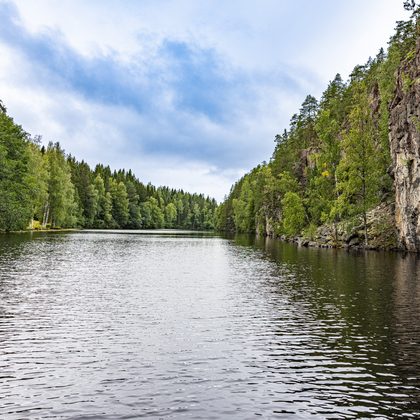
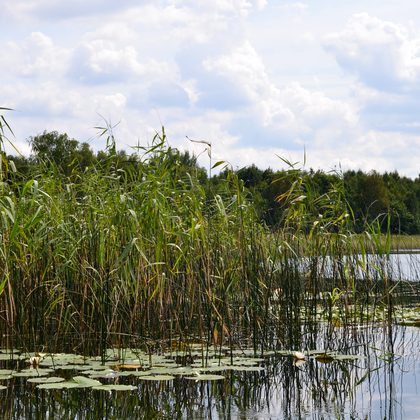
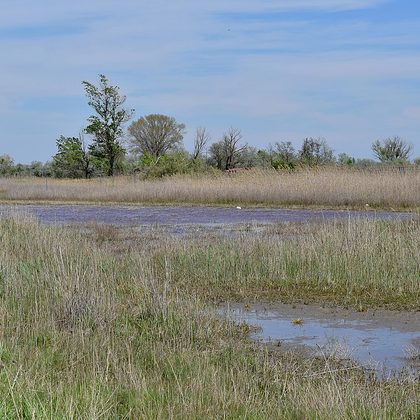
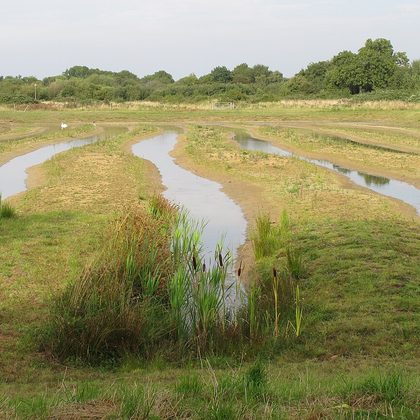
Shallow, often slightly saline inland water: clay pits and flooded fields, brackish inlets and borrow pits, sewage lagoons, saltworks and temporarily flooded grassland. It walks the waterline and wades above the tarsus, scything through the surface, and only occasionally swims. Breeds in the interior of western North America on wet prairie marshes and sedgy hay meadows around shallow lakes. On migration tens of thousands gather on large saline lakes.
Where the bird is most at home, classified with EUNIS — the European standard for habitats.
Range and movements
Breeds on the prairies and intermontane basins of western North America and winters on saline lakes in the Andes and on the salt flats and lagoons of Argentina and Bolivia. In Europe it is a scarce but reasonably regular vagrant, with Britain and Ireland recording it most years. The Netherlands stood at twenty-six accepted records to the end of 2022, spread over April to November with the bulk from July to October, most of them in Flevoland, on Texel, in the north of Noord-Holland and in Zeeland. Spain reached twelve accepted records to 2004, the first in 1971: eight in autumn with a peak in October and four in spring, all in May.
Where and when to look
Work fresh and brackish inland water rather than the coast: sewage lagoons, brackish inlets, flooded fields and clay pits from July to September give the best odds. Scan the mud edges as well as the water, because the bird often walks among Ringed Plovers and Greenshank without drawing attention. A non-breeding bird gives itself away by sheer pallor: a plain, pale grey wader with no streaking, a long fine black bill and yellow legs is nothing else in Europe. If it flies, look at the wing, because the absence of a white wing-bar rules out both other phalaropes at once.
Conservation status
Least Concern. The world population is of the order of one and a half million birds, but counts point to a decline and the species is more vulnerable than that figure suggests. The reason is concentration: in late summer hundreds of thousands gather to moult on a handful of large saline lakes in western North America, among them Mono Lake and the Great Salt Lake, where water abstraction lowers levels and drives salinity to the point where the brine shrimp and brine flies the birds live on cannot survive. On the breeding grounds the loss of prairie wetlands to drainage matters, and in the Andes the extraction industry on the salt flats.