All species › Gamebirds › Pheasants and partridges › Willow ptarmigan
Willow ptarmigan
Lagopus lagopus | Moerassneeuwhoen | Lagópodo común
The heavy, warm-toned ptarmigan of the willow scrub and the birch belt, and the bird that British and Irish observers meet as Red Grouse at home. In Lapland it is on every itinerary and still a surprise every time, because it sits until you nearly tread on it and then goes off barking.

Voice
Loud and hoarse, and the defining sound of the Lapland fells in May. The cock climbs steeply, beats his wings and delivers a barking ka-ka-KAAAA-ka-ka-ka that rolls across the scrub like a jeering laugh, then planes down with tail spread. Flushed birds bark a hard kek-kek-kek. It carries for kilometres over open ground and is given from first light through the pale hours of the night.
No freely licensed recording is available for this species yet.
Identification
A stout, thickset grouse with a deep, heavy bill and fully feathered feet. Winter birds are entirely white with a black tail and no loral stripe. In spring the cock has a chestnut head, neck and breast against a still-white body and a swollen red comb; in summer the whole bird is warm rufous with coarse dark barring, the belly and wings staying white. Autumn plumage is warm brown and broadly barred. The photograph shows a bird in summer plumage at Abisko in Swedish Lapland.
Confusion species
Rock Ptarmigan sits higher on the same fells and is the only real pitfall. In white winter plumage only the cock Rock Ptarmigan carries a black loral stripe from bill through eye; Willow Grouse never shows one, but hen Rock Ptarmigan lacks it too, so its absence rules nothing out. In summer Willow Grouse is warm rufous with coarse barring against the cold grey, finely vermiculated Rock Ptarmigan. In autumn it is warm brown where Rock Ptarmigan is uniform ash-grey. At any season the bill decides it: deep and heavy on Willow Grouse, small and slight on Rock Ptarmigan. Red Grouse stands outside this sequence, being the only one of the three that never turns white.
Habitat
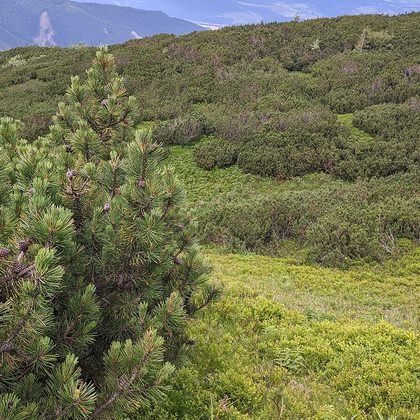
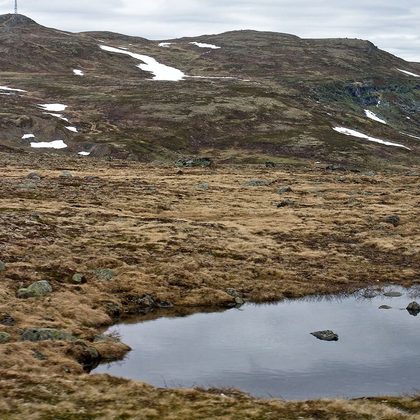
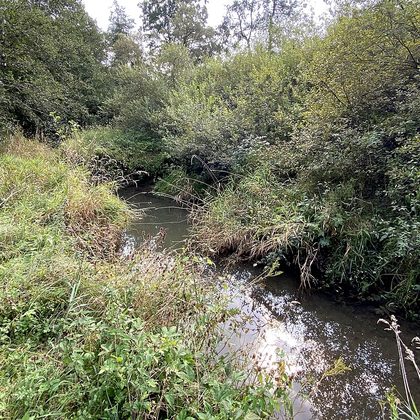
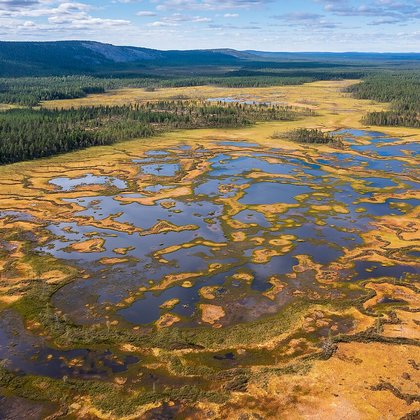
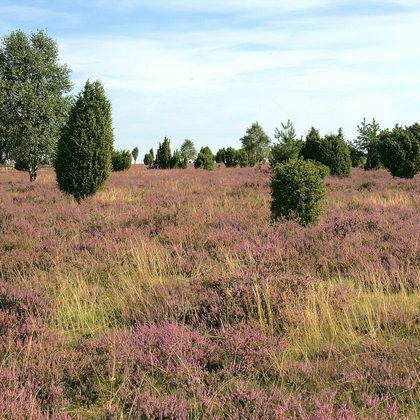
The scrub belt just below and just above the tree line: willow thickets along streams, dwarf birch, wet mire edges and open birch woodland. Also lowland raised bog and aapa mire carrying plenty of dwarf shrubs. Through the winter the diet is almost entirely birch and willow buds and catkins, and the birds roost in burrows dug into the snow.
Where the bird is most at home, classified with EUNIS — the European standard for habitats.
Range and movements
Norway and Sweden through Finnish Lapland and northern Russia into the taiga, with a second large range across northern North America. Britain and Ireland hold their own resident form, given its own entry in this guide as Red Grouse. It is not a vagrant to western Europe; to see one you travel north.
- Resident
- Breeding (summer)
- Winter
- Passage
- dark = core range, pale = thinly spread
Where and when to look
Walk a valley track at Abisko, Kilpisjärvi or on the Dovrefjell in the second half of May, in the hours around midnight when the light is low and the cocks are calling. Stay on the edge between birch woodland and open fell and let your ears do the work, since the barking usually comes from a low bush or a boulder where the cock is sitting in the open. Later in the season hens with broods walk the forest tracks, but by then the noise has largely stopped.
Conservation status
The world population is large and the species is not threatened, but Fennoscandian numbers have fallen for decades. The research points at increasingly snow-free springs, which leave white birds on dark ground, at wetter and colder weeks when the chicks are small, and at the flattening of the rodent cycles that normally keep predators away from grouse nests. Hunting is regulated in Norway, Sweden and Finland, with bag limits and shortened seasons in poor years.