All species › Swifts › Swifts › White-rumped swift
White-rumped swift
Apus caffer | Pijlstaartgierzwaluw | Vencejo cafre
The White-rumped Swift is a small, very slender swift with a narrow white crescent across the rump and a long, deeply forked tail. In southern Spain it breeds almost entirely in the mud nests of Red-rumped Swallows, which it takes over under bridges, in caves and beneath eaves. It is one of the few African birds to have reached Iberia as a breeder under its own power.

Voice
Not very vocal and easily overlooked. The call is a low, throaty trill often likened to the squeak of a bat, tsirrr, almost always given at the nest and rarely high in the air. Listen under an occupied bridge in the middle of the day, when the adults are moving in and out of the mud nests.
No freely licensed recording is available for this species yet.
Identification
At 14–15.5 cm it is slightly shorter than a Common Swift, but the narrow body and thin wings make it look much smaller and sharper. The plumage is glossy blackish brown; the throat shows a small, sharply defined white patch, and a narrow white crescent crosses the rump without continuing onto the flanks. The tail is long and deeply forked, but it is usually held closed in flight so that it looks like a single spike, the fork opening only on a turn. Flight is fast, with tight turns and short glides, and the bird is normally seen singly or in pairs among Common Swifts.
Confusion species
Common Swift is bigger (17–18.5 against 14–15.5 cm), with stiff scythe-shaped wings, a short forked tail and uniform sooty brown plumage showing at most a pale throat patch; it never has a white rump. Pallid Swift is browner, with a stronger head and throat pattern and broader-based wings, and also lacks a white rump. Alpine Swift is far bigger and has a white belly, not a white rump. Among the three small white-rumped swifts, White-rumped Swift is the slimmest and has the longest and most deeply forked tail; its white band is the narrowest and the only one that fails to reach the flanks, and its white throat is the smallest. Little Swift is smaller and stockier, with a broad square band running well onto the flanks and a square-cut tail. Horus Swift is intermediate: a broad band ending on the rear flanks, and a shallow fork.
Habitat
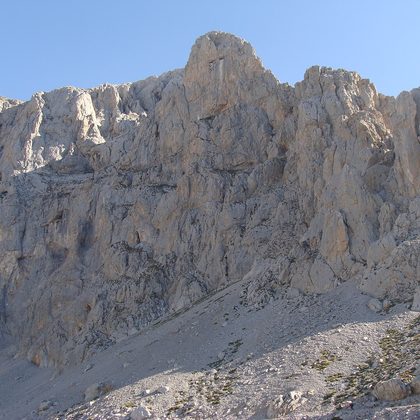
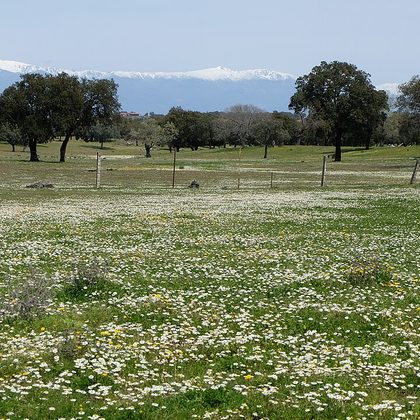
Breeds under road and railway bridges, in culverts, tunnels and caves in rock faces, always where Red-rumped Swallows have built their retort-shaped mud nests. Hunts over dehesa, olive groves, farmland and river valleys, often low over water and scattered trees.
Where the bird is most at home, classified with EUNIS — the European standard for habitats.

Range and movements
An African species that has bred in south-west Iberia since the middle of the last century: it was found near the Strait of Gibraltar in 1964 and breeding was confirmed in 1967. The Spanish population is put at some 100–150 pairs, thinly spread over about ten provinces, with roughly eighty per cent in Cádiz and Córdoba and the northern limit in Cáceres and Toledo. Birds arrive in late April or May and leave between late October and early November, later than almost any other migrant on the peninsula. Within the area of this guide the only other breeding grounds are in northern Morocco; it has never been recorded in Britain or the Netherlands.
- Breeding (summer)
- Passage
- Migration direction
- dark = core range, pale = thinly spread
Where and when to look
Pick a stone or concrete bridge over a river or stream in the Cádiz sierras, in Córdoba or in northern Seville province, and scan the mud swallow nests against the arch between June and September. Keep your distance from the nest mouth: the swifts fly straight in and are easy to follow from well back.
Conservation status
Not globally threatened (IUCN: Least Concern) and if anything increasing, partly because new bridges provide extra sites for the Red-rumped Swallow nests on which the species depends. In Spain the population remains very small and the national red data book lists it as Vulnerable. The main risks are cleaning and repair work on bridges and tunnels during the breeding season, and the routine removal of swallow nests.