All species › Tubenoses › Southern storm petrels › White-faced storm-petrel
White-faced storm-petrel
Pelagodroma marina | Bont stormvogeltje | Paíño pechialbo
The White-faced Storm-petrel is the odd one out among the storm-petrels: a pale, long-legged bird that looks more like a phalarope than a petrel and crosses the sea in bouncing hops. Within the area of this guide it belongs to two island groups, the Selvagens and the Canaries, and is almost never seen from land.

Voice
Silent at sea. At the colony at night, from inside the burrow and from birds on the ground, comes a soft moaning coo, oooo-ah, and a quicker wik-wik-wik between the pair. These are quiet sounds that do not carry far and are easily buried under the wailing of the shearwaters nesting alongside, so most of what a visitor hears on the Selvagens on a spring night comes from underground rather than from the air.
No freely licensed recording is available for this species yet.
Identification
Unmistakable once seen at all well. The underparts are white from chin to undertail, the face is white with a broad dark stripe through the eye and a grey-brown crown, and the upperparts are grey brown with a paler grey rump — a grey panel, not a white band. The tail is square and dark and the long black legs trail well beyond it, ending in webs that are pale yellow with dark edges. The wings are long and broad and are held stiffly, often slightly raised, with white coverts below and a dark trailing edge. The flight settles it: a series of bounding hops in which the bird strikes the water with both legs held together and swings sideways in high little arcs, like a puppet on strings; when feeding it hangs into the wind, paddling and picking from the surface.
Confusion species
No other storm-petrel in the area is white below, so the danger lies not with European, Leach's or Band-rumped Storm-petrel — all dark birds with a white rump — but with small waders and terns at long range. Grey Phalarope in winter plumage has much the same white face with a dark eye-patch, but it swims, carries a needle-fine bill and shows a clean white wing bar. Little Tern and Black Tern are longer and narrower in the wing, fly on steady beats and never bounce off the water on their legs. The face pattern, the grey rump, the trailing legs and the hopping flight taken together leave no room for doubt.
Habitat
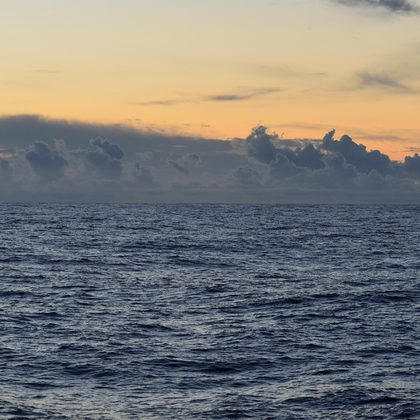
Pelagic outside the breeding season, over deep water well away from land, feeding in bounding hops and short hovers on planktonic crustaceans and small fish taken from the surface. It breeds on flat or gently sloping ground on small islands, digging a shallow burrow in soft soil or nesting under mats of low vegetation — a quite different setting from the rock crevices used by the dark storm-petrels. Colonies are visited only at night and survive only where rats and cats are absent.
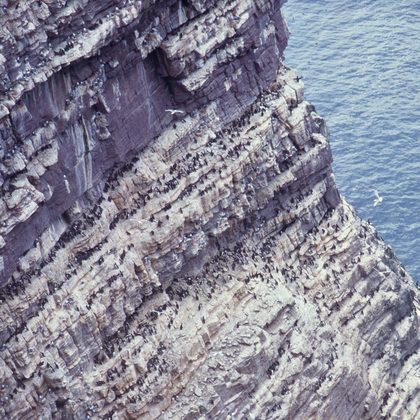
Where the bird is most at home, classified with EUNIS — the European standard for habitats.
Range and movements
Within the area of this guide it breeds on the Selvagens, which hold the great bulk of the world population of the Macaronesian form — a count in 1996 gave some 61,000 pairs, 36,000 of them on Selvagem Grande — and in far smaller numbers on the Canarian islets of Montaña Clara and Alegranza. Birds attend the colonies from late winter until July and spread over the open Atlantic afterwards; the Cape Verdes hold a further population just outside the map. Other populations breed in the South Atlantic, off southern Australia and around New Zealand.
- Breeding (summer)
- Passage
- dark = core range, pale = thinly spread
Where and when to look
A boat is essential. Between April and July a pelagic out of Lanzarote towards the Chinijo islets, or a trip from Madeira in the direction of the Selvagens, gives the realistic chance; look for a small pale bird bouncing across the swell rather than for a storm-petrel shape. Calm weather helps, because the hopping flight is the thing you are looking for and it is lost in a heavy sea. Evening trips are better than midday ones, when the light flattens the face pattern.
Conservation status
Not globally threatened (IUCN: Least Concern), on the strength of the very large colony on the Selvagens, but the picture inside our area is uneven: the Canarian population is small and restricted to two islets, and is easily damaged. Introduced rats, cats and rabbits, which take eggs and chicks or trample the burrows, are the main threat, together with light pollution that grounds fledglings on the neighbouring inhabited islands. Removing introduced mammals from the breeding islands is the measure that has done most for the species.