All species › Waders, gulls and terns › Sandpipers and snipes › Slender-billed curlew
Slender-billed curlew
Numenius tenuirostris | Dunbekwulp | Zarapito fino
The palest and finest of the curlews, and the only species in this guide for which the evidence points to there being no living birds left. Anyone learning it now works from old plates, a handful of photographs from the 1980s and 1990s, and the skins in museum drawers.
No freely licensed photograph of a living wild bird of this species exists.
Voice
Older accounts described a coor-lee in the manner of Curlew but higher, shorter and thinner, with less carrying power, plus a sharp kwee-kwee in alarm. Recordings barely exist, and what survives is fragmentary and buried in background noise. Nobody could realistically identify this bird by ear, which is a large part of why every claim had to stand or fall on photographs.
No freely licensed recording is available for this species yet.
Identification
Slightly smaller than Eurasian Curlew and much slimmer, with longer legs and a more upright stance. The bill is short for a curlew, about one and a half head-lengths, tapering evenly to a fine point and curved only near the tip; on adults it was uniformly dark, without the pale base of a Curlew. The crown is dark and lacks a median stripe. Underparts are white with sharply defined round to heart-shaped black spots on the flanks, not streaks or chevrons. Rump, lower back and tail are white with narrow dark bars, and the underwing and axillaries are clean white against blackish primaries. Legs were grey-blue.
Confusion species
Whimbrel and Eurasian Curlew are the two reference points. Against Curlew, Slender-billed is smaller, paler and far slimmer, and the bill is the clearest difference: Curlew carries a long, evenly decurved bill of two to three head-lengths with a pinkish base, Slender-billed a short, fine, evenly tapering bill that bends only at the tip. Against Whimbrel it is about the same length but longer-legged and slighter, and it lacks the bold crown striping that makes Whimbrel so instantly recognisable. The decisive character is on the flanks: discrete round or heart-shaped black spots on white, where Whimbrel and Curlew show streaks, arrowheads or bars. Add the strikingly white tail with few narrow bars, against the more heavily barred and browner tails of the other two. Juvenile Slender-billed had streaked rather than spotted flanks, which is exactly why claimed birds were so hard to nail down.
Habitat
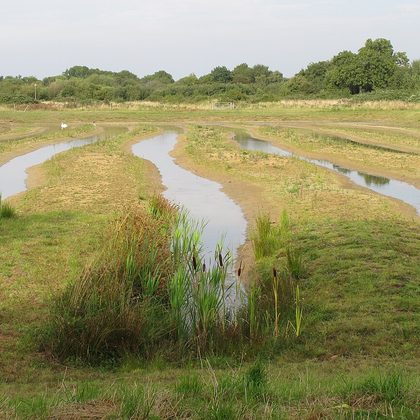
Wintered on shallow brackish and saline coastal marshes, lagoons with exposed mud, saltpans and adjoining wet meadows around the Mediterranean and along the Atlantic coast of Morocco; the last regular birds used the lagoon at Merja Zerga. On passage, parties were reported from steppe and salt lakes across Central Asia and eastern Europe. Breeding habitat is described with certainty from one area only: peat bogs and wet openings in the forest belt north of Omsk in Siberia, where nests were found between 1909 and 1925. Isotope work on museum feathers points to a main breeding belt further south, running through Kazakhstan near the fiftieth parallel.
Where the bird is most at home, classified with EUNIS — the European standard for habitats.



Range and movements
Historically a bird of the flyway between western Siberia and north-west Africa, with winter concentrations in Morocco, Tunisia, Italy, Greece and Turkey, and passage across the Black Sea and the Balkans. The much-discussed Druridge Bay bird of May 1998, in Northumberland, was accepted at the time and then removed from the British List after review in 2014. The Netherlands has nine accepted records, all between 1856 and 1947 and three-quarters of them from November to February, which shows this was once a regular if scarce winter visitor to north-west Europe. World counts never exceeded a few hundred birds at any one time.
Where and when to look
There is nothing left to look for, and saying so plainly is more use than inventing a search tip. What does help is knowing the character set well enough to recognise the trap, because every few years a pale, fine-billed curlew somewhere around the Mediterranean gets reported as this species. If you ever face that bird, photograph the spread tail, the underwing and the flanks, because those three settle it. To see one in the flesh, go to a collection: Naturalis in Leiden holds a skin, and the larger European natural history museums between them hold several hundred.
Conservation status
This is the hardest case in the guide. The last generally accepted record is a photographed bird at Merja Zerga, Morocco, in February 1995, more than thirty years ago. Everything claimed since has either failed review or remained contested. A quantitative assessment published in November 2024, led by Graeme Buchanan of the RSPB, put the probability that the species is gone at over ninety-nine per cent, with extinction most likely in the mid-1990s. The IUCN moved the Slender-billed Curlew to Extinct on 10 October 2025. This guide's status field only runs as far as Critically Endangered, so CR is what is recorded here; that is a limitation of the book, not a statement about the bird. What finished it off was never established: the factors usually named are hunting along the flyway, drainage of the Siberian peatlands and loss of Mediterranean wetlands, acting on a population that was already small. The lesson that does hold is that a species which is both rare and whose breeding grounds remain unknown is in practice impossible to protect.