All species › Birds of prey › Hawks, eagles and kites › Rough-legged hawk
Rough-legged hawk
Buteo lagopus | Ruigpootbuizerd | Busardo calzado
The Rough-legged Buzzard is the arctic cousin of the Common Buzzard, arriving in winter on open, vole-rich polders and saltmarsh. It is paler, longer winged and above all recognisable by its tireless hovering.

Voice
Usually silent in the winter quarters. In disputes with Common Buzzards or crows it gives a drawn-out, plaintive peeee-yoo, thinner, higher and even more cat-like than the familiar mewing of a Common Buzzard. The chance of hearing it is small and limited to territorial skirmishes over good hunting ground; on the arctic breeding grounds it is far more vocal.
No freely licensed recording is available for this species yet.
Identification
Slimmer and longer in wing and tail than a Common Buzzard, with a pale head and breast. The tail is decisive: clean white at the base with a sharply defined broad dark terminal band — a single band in females and juveniles, several narrower bands in the adult male. Add a dark, often nearly black belly patch standing out against a pale breast, and large black carpal patches on a mostly white underwing. Juveniles show a more diffuse, broadly diluted tail band, a more uniformly dark belly patch and a pale iris. It hovers persistently in one spot into the wind, higher than a Common Buzzard, and soars with the wings in a shallow V.
Confusion species
Common Buzzard is the only real confusion species and is hugely variable, so work through the list. Rump and tail base: clean white with a crisp black terminal band in the Rough-legged, finely barred and often washed rufous in the Common, without that contrast. Belly patch: a compact dark apron against a pale breast in the Rough-legged, whereas pale Common Buzzards show a broken dark band across the flanks. Carpal patches: larger, blacker and more sharply defined in the Rough-legged. Hovering: a Common Buzzard hovers briefly and low, often clumsily, while a Rough-legged hangs motionless in the wind for minutes at ten to thirty metres — that behaviour alone is a strong pointer on a distant bird. Hen Harrier also quarters the same fields low, but is far narrower winged, with a long slim tail and a white rump without a terminal band.
Habitat
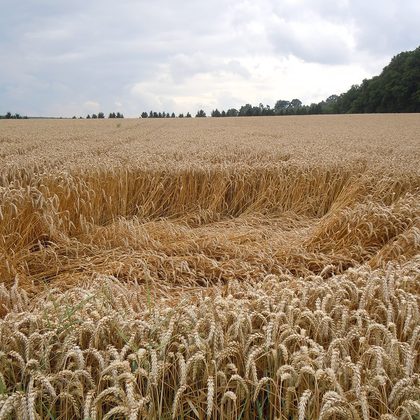
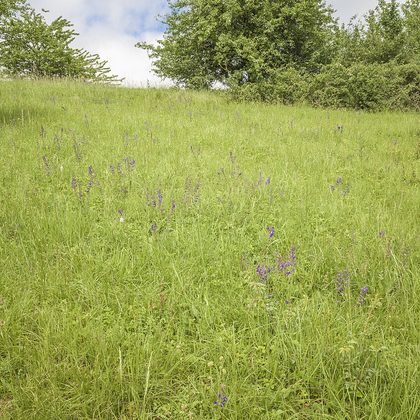
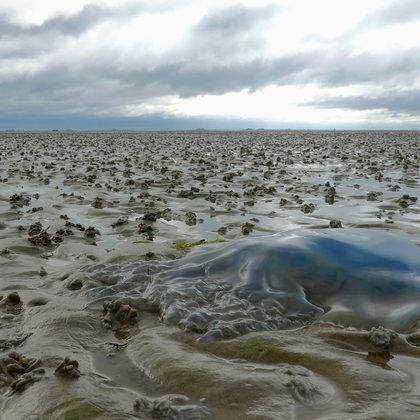
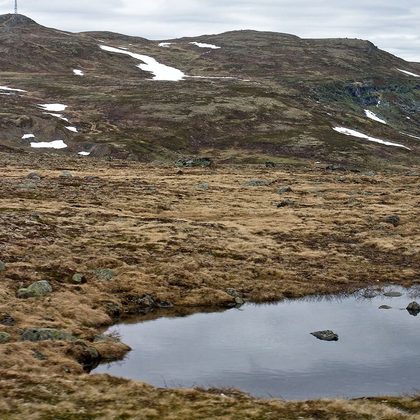
Extensive open country without tall growth: saltmarsh, newly reclaimed polders, rough arable, drained flats, dune slacks and sea dykes. It hunts voles almost exclusively, hovering or watching from a post, a hay bale or simply the ground. Breeds on tundra and cliff ledges in northern Scandinavia and Russia.
Where the bird is most at home, classified with EUNIS — the European standard for habitats.
Range and movements
A winter visitor from Fennoscandia and northern Russia. In the Netherlands it favours the Wadden region and the young polders: the Lauwersmeer, the Wadden islands, the Groningen and Friesland saltmarshes, Flevoland and the Oostvaardersplassen. Numbers swing sharply from year to year, tracking lemming and vole cycles in the north; a good winter brings tens, a poor one barely a single bird. In Spain it is a distinct vagrant, with only a handful of accepted records, almost all in the north.
- Resident
- Breeding (summer)
- Winter
- Passage
- Migration direction
- dark = core range, pale = thinly spread
Where and when to look
Between late November and February, take a windy day at a large open site such as the Lauwersmeer or the saltmarshes of Terschelling and Texel: wind is exactly what makes the bird hover longest and most conspicuously, which is how you pick it out among the resident Common Buzzards. Scan the fence posts and hay bales along the fields too, and watch every buzzard that takes off — the white tail base with its black band usually clinches it as the bird pulls away.
Conservation status
Not globally threatened (IUCN: Least Concern), but the number of birds wintering in north-west Europe has clearly fallen over recent decades. Strong year-to-year fluctuations make the trend hard to read; changing rodent cycles in the Arctic and milder winters, which let birds stop short of moving so far south, probably both play a part.