All species › Waders, gulls and terns › Sandpipers and snipes › Red-necked stint
Red-necked stint
Calidris ruficollis | Roodkeelstrandloper | Correlimos cuellirrojo
A Siberian stint that belongs in Australia and turns up here as a mega, almost always an adult in full or fading breeding dress in July. Ireland stands at six records, three of them at Ballycotton.

Voice
A coarse, slightly squeaky chit or prip, also given as a short pit-pit-pit, lower and hoarser than the short dry stit of Little Stint. In Britain and Ireland this is a single bird in a Little Stint or Dunlin flock, so the call usually comes only as the flock lifts. If a suspect bird will not show its rear end or its throat pattern on the deck, putting the flock up deliberately is a fair trade for the call and the wing formula.
No freely licensed recording is available for this species yet.
Identification
Small, elongated and short-legged, with a short bill that is deep at the base and tapers to a fine tip, and black legs with unwebbed toes. Structure gives it away first: short tarsi, a long rear end and primaries projecting clearly beyond the tail. In breeding plumage the face, throat and upper breast are an even brick red with no streaking within the red itself, bordered below by a necklace of dark streaks on a white breast. Juveniles look greyer and plainer than juvenile Little Stint, with rufous-fringed upper scapulars against plain grey lower scapulars and coverts, weak mantle braces and a grey wash on the breast sides. Winter birds are plain grey above with a pale grey breast patch.
Confusion species
Little Stint is the whole problem. In summer Little Stint shows a white chin and throat and streaking running through the orange-red, while Red-necked Stint has the red clean and unmarked on the throat with the streaks gathered below it as a necklace. As juveniles Little Stint has bright white mantle braces, a split supercilium and black-centred scapulars with rufous fringes, whereas Red-necked looks flatter and plainer, with a greyer crown, dull grey lower scapulars and only faint braces. Structure separates it from the rest as well: on Little Stint the wing tips reach about the tail tip, on Red-necked they clearly overshoot it, and on Temminck's Stint the tail projects past the wing tips instead. From Western and Semipalmated Sandpiper it differs in lacking webs between the toes, worth checking on a bird wading a shallow film of water; Western adds a longer bill drooping at the tip and rufous scapulars, Semipalmated a blunt straight bill and a densely streaked breast band. Least Sandpiper falls out on yellow-green legs, a finer and slightly decurved bill, browner streaked plumage and a complete breast band. Temminck's Stint has yellow-olive legs, an even grey breast and white outer tail feathers, and creeps rather than runs.
Habitat
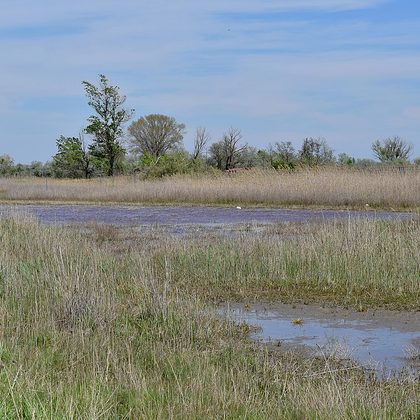
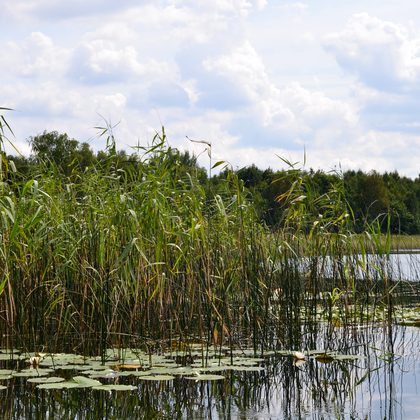
In Europe on estuarine mud, coastal lagoons, saltmarsh creeks, brackish pools and saltpans, and on the muddy margins of sewage works and reservoirs, always among Little Stints or Dunlin. Breeds on dry herb-rich tundra along the arctic coast of north-east Siberia. Outside Europe this is a bird of the vast intertidal flats of the East Asian flyway, feeding by fast, pecking runs across soft mud.
Where the bird is most at home, classified with EUNIS — the European standard for habitats.


Range and movements
Breeds along the arctic coast of north-east Siberia and winters in South-East Asia and Australasia as far south as Tasmania and New Zealand. Western European records are of birds that have drifted or stayed west, spread from May to November with a marked concentration in July, and the great majority are adults; the only juvenile documented in Europe was one found dead on Fair Isle on 31 August 1994. Ireland has six records, three of them at Ballycotton, in 1998, 2002 and July 2024, with Reenroe in Kerry in August 2011 in between. The Netherlands has seven, three on Texel.
Where and when to look
July, and coastal pools rather than open tideline. Work the scrapes, lagoons and saltmarsh pools that hold returning adult Little Stints and Dunlin in the first half of the month, from Ballycotton and Tacumshin round to the east coast reserves. Look at the back end of every stint: primaries clearly overshooting the tail on a bird that otherwise reads as a Little Stint is the feature that has found most of these records, and the clean red throat with the streak necklace below it confirms it.
Conservation status
Near Threatened. Outside the breeding season the species depends on the East Asian flyway, where reclamation and hardening of the tidal flats around the Yellow Sea have removed large areas of staging habitat. Counts along that route show rapid declines in almost every shorebird that uses it. In Australia lower arrival weights and shrinking numbers are being recorded at traditional non-breeding sites.