All species › Falcons › Falcons › Red-footed falcon
Red-footed falcon
Falco vespertinus | Roodpootvalk | Cernícalo patirrojo
The Red-footed Falcon is the most elegant of our small falcons: a colonial breeder of the eastern European steppe edge that sometimes arrives in western Europe by the dozen in May. It hunts insects like a Kestrel but has the long wings and buoyant flight of a Hobby.

Voice
Noisy at the colony: a high, fast, rather chattering ki-ki-ki-ki, thinner and quicker than a Kestrel's, plus a sharper kew-kew. On passage in western Europe it is almost always silent, so you must work from silhouette and plumage.
Recording: Bubulcus — CC BY 3.0 · Wikimedia Commons
Identification
Slightly smaller and slimmer than a Kestrel, with long pointed wings and a medium tail; in flight a cross between Kestrel and Hobby. The adult male is unmistakable: uniform dark slate-blue-grey with rusty-red trousers and vent and striking orange-red legs, cere and eye-ring; in flight the silvery-grey upper surface of the primaries stands out against the otherwise dark plumage. The female is one of Europe's loveliest raptors: an orange-ochre crown and unstreaked underparts, a finely barred blue-grey upperside, and a white face with a small black eye mask and a narrow black moustache. First-years resemble the female but have white to cream underparts with dark streaks, a scaly upperside and a more clearly barred tail; their legs are yellow-orange rather than red. It hovers regularly, but more loosely and briefly than a Kestrel, and perches readily on wires and dead branches.
Confusion species
Hobby is the main confusion species in flight: longer and narrower in the wing, with a short tail, a sharp black-and-white head pattern with a broad moustache and dense black streaking on a white breast; it does not hover. On a female Red-footed the unstreaked orange underparts and the small mask settle it. First-year Red-footed is the hard one: it does have streaked underparts and so recalls a juvenile Hobby closely, but its moustache is narrow and short rather than broad and wedge-shaped, its forehead and throat are cream, its underparts are warmer and less sharply streaked, and its vent is pale rather than dark. Kestrel has shorter, blunter-tipped wings, a longer tail, a spotted rufous back and hovers steadily over one spot for long periods.
Habitat
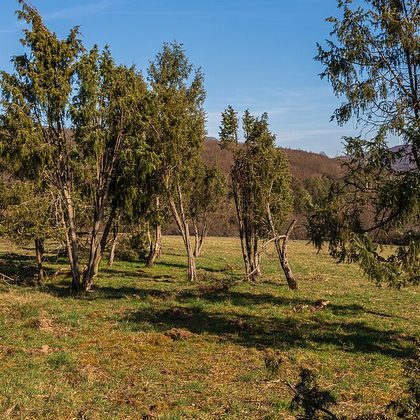
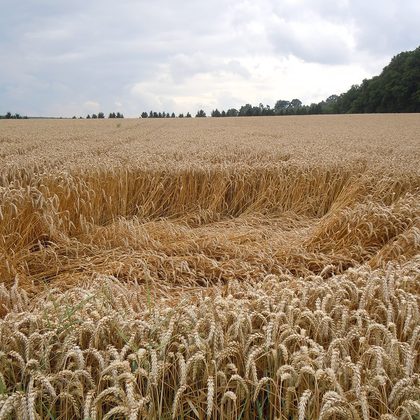
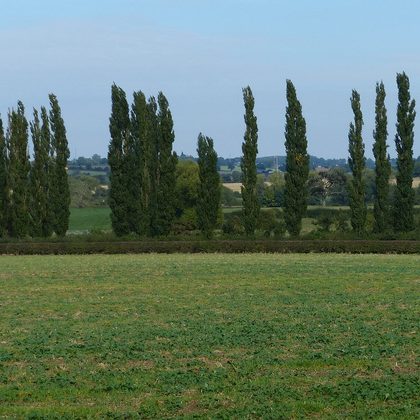
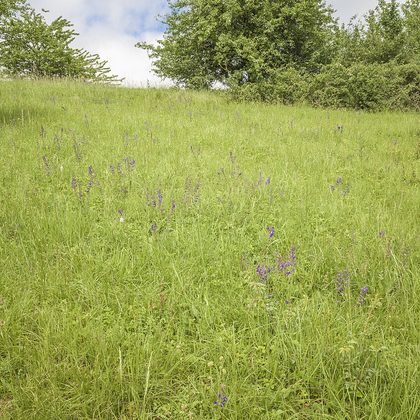
Breeds colonially in old rook colonies and magpie nests in tree groups and shelterbelts set in open steppe, arable land and grassland in eastern Europe. It hunts over short grassland, lucerne, stubble and along woodland edges, often in loose parties and preferably in the late afternoon when grasshoppers, beetles and dragonflies are active. On passage in western Europe it turns up over grassland, marshes and polders and perches on power lines and fence posts.
Where the bird is most at home, classified with EUNIS — the European standard for habitats.
Range and movements
Breeds from Hungary, Serbia and Romania east through Ukraine and Russia to Central Asia; the whole population winters in southern Africa. The Netherlands lies outside the breeding range, but every May — especially on warm south-easterly winds — dozens and occasionally more than a hundred birds appear, with regular concentrations in the Flevo polders, the river district and along the Wadden coast. In Spain it is a scarce but annual spring migrant, most often recorded in the Ebro valley and along the east coast.
- Breeding (summer)
- Passage
- Migration direction
- dark = core range, pale = thinly spread
Where and when to look
The second and third weeks of May, on a warm south-easterly airflow. Drive open polder country and scan power lines, fence posts and isolated dead trees: Red-footed Falcons perch high and conspicuously and hunt over short grass towards evening. Once you have a bird, go straight to the leg colour and the vent, because on females and first-years the identification stands or falls on those.
Conservation status
Near Threatened (IUCN). The European breeding population has fallen sharply in recent decades through the loss of the rook colonies it depends on for nest sites, agricultural intensification and insecticide use, and electrocution on medium-voltage pylons. Nest-box schemes in colonies in Hungary and Serbia have reversed the trend locally, but the species remains tied to insect-rich, extensively farmed land.