All species › Passerines › Chats and flycatchers › Northern wheatear
Northern wheatear
Oenanthe oenanthe | Tapuit | Collalba gris
Northern Wheatear is the bird of bare ground: dune slacks, cut heath, drifting sand and stony slopes, where it stands upright on a clod or a rock and jerks off in a short low flight to the next perch. As a Dutch breeding bird it has all but gone within two generations; as a migrant it still turns up on the coast every spring and autumn.

Voice
The song is a short, hurried phrase of hard scratchy and squeaky notes mixed with clear whistles and a good deal of mimicry, delivered from a stone or in a brief fluttering song flight. The call is the trademark and explains the old English name: a hard, stony chack or tak-tak, like two pebbles knocked together, often preceded by a thin rising hweet. Heard from March into August, and on migration independently of song.
Recording: British Library — CC BY-SA 4.0 · Wikimedia Commons
Identification
Slim, long-legged and short-tailed, always upright and constantly bobbing. The tail pattern in flight is the character to rely on, because often it is all you get: a broad, bright white panel across the rump and tail base, and below it a black inverted T formed by a wide terminal band and a narrow central stripe. The summer male has blue-grey upperparts, a black mask from bill to behind the eye, a white supercilium and an orange-buff breast. The female is warm sandy brown with a faint mask and a pale supercilium, but exactly the same tail. In autumn every bird — female, juvenile or moulting male — is brown with creamy fringes and buff underparts, and the tail is then the only certain feature; that is the plumage in which the species is most often seen here.
Confusion species
The southern wheatears are where the real difficulty lies, in Spain and among vagrants. Black-eared Wheatear shows far less black in the tail — the terminal band is narrow and the central stripe almost absent, so the tail looks nearly all white — and has creamy to buff, not grey, upperparts; the male also shows a black throat or a black ear patch running onto the mantle. Black Wheatear is large and entirely black with a white rump and the same broad terminal band. Isabelline Wheatear is paler, bigger and longer-legged, with a shorter tail in which the black terminal band is broader than on Northern Wheatear so that the white rump looks relatively small; it has a plainer face and a more upright, longer-legged stance. Whinchat lacks the white rump panel altogether, showing white tail-base patches and a streaked back.
Habitat
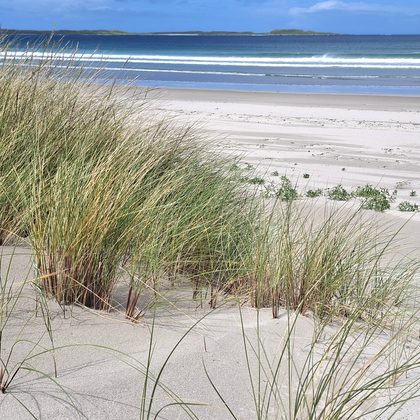
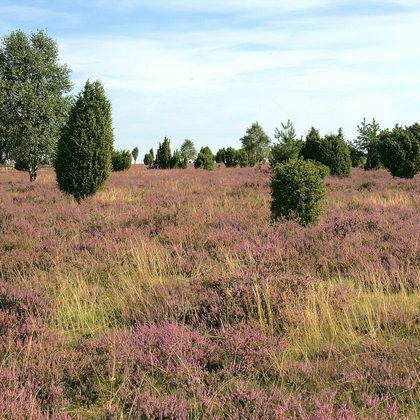
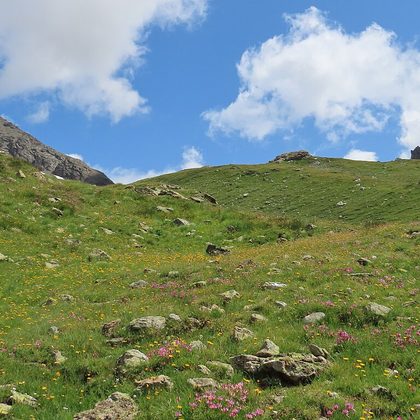
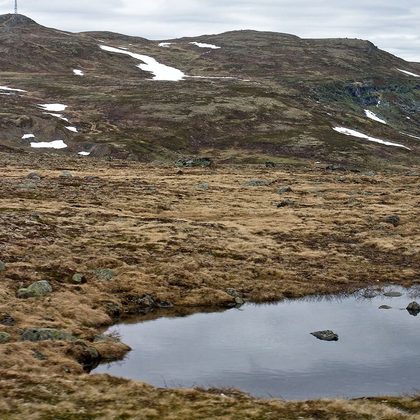
Short, open, bare ground with lookout perches and cavities to nest in: dune slacks with open sand, cut and grazed heath, drifting sand, stony alpine pasture, blanket bog and rocky tundra. The nest goes in a rabbit burrow, under a stone or in a wall crevice. On coastal passage on groynes, sea walls, saltmarsh, fields with bare patches and even car parks.
Where the bird is most at home, classified with EUNIS — the European standard for habitats.

Range and movements
Breeds from Greenland and Iceland to Siberia and south into the mountains of southern Europe; all birds winter in sub-Saharan Africa, including the Icelandic and Greenland birds, which cross the ocean in a single hop. In the Netherlands the breeding population has collapsed: from over two thousand pairs around 1975 to roughly three hundred pairs today, almost all in the dunes of North Holland and the Wadden islands, with small remnants on the Veluwe. North Brabant, Limburg and much of the coast have been abandoned entirely. In Spain it is a widespread breeder of mountains and high plateaux and a very numerous migrant in March and September.
- Breeding (summer)
- Winter
- Passage
- Migration direction
- dark = core range, pale = thinly spread
Where and when to look
The last week of March and the first week of April on a sea wall, a groyne or a saltmarsh: the first males arrive then in full summer plumage and sit out on the stones, often at a few metres. For the Greenland form leucorhoa — bigger, more orange and longer-winged — the first half of May on the Wadden islands is the moment. In August and September the brown autumn birds stand on fields with bare patches; flush one and watch nothing but the tail, since the black inverted T settles the identification at once.
Conservation status
Least Concern globally, but one of the fastest-declining breeding birds of western Europe. In the Netherlands it is listed as Endangered nationally: dunes and heaths grown rank through nitrogen deposition, the loss of short open vegetation, the collapse of rabbit numbers that once provided nest holes, and rising recreational pressure and predation. Large-scale sod-cutting, grazing and the restoration of bare sand in the dunes have locally halted the fall, but the recovery is fragile. In the Mediterranean and in Scandinavia numbers are considerably more stable.