All species › Gannets and cormorants › Gannets › Northern gannet
Northern gannet
Morus bassanus | Jan-van-gent | Alcatraz atlántico
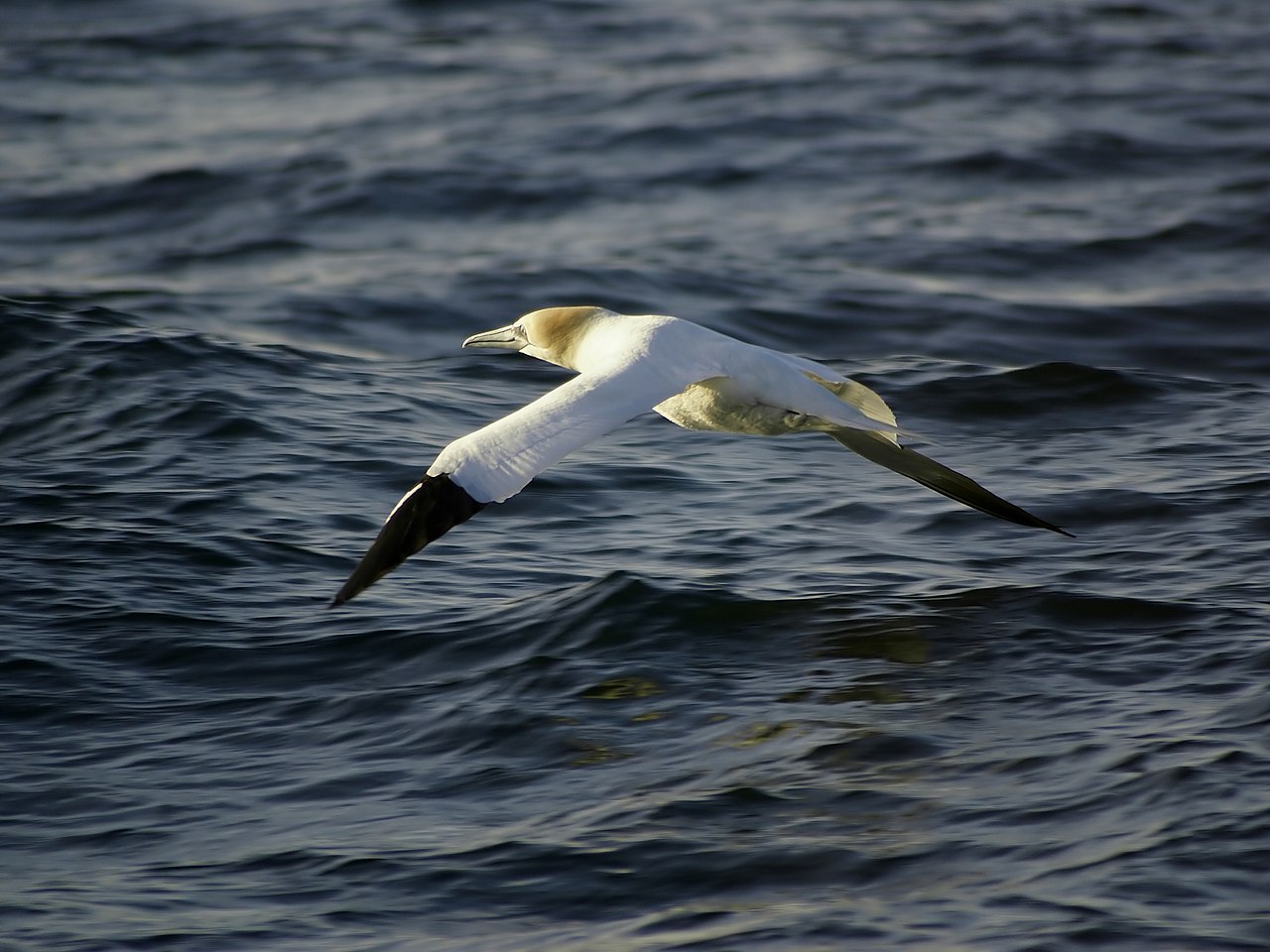
The Northern Gannet is the largest seabird of the North Sea and the only one that drops from thirty metres into the water like a thrown spear. A party of gannets working a shoal of herring is one of the most spectacular things you can watch from a Dutch pier.
Voice
Almost silent at sea, at most a hoarse croak when squabbling over a shoal. At the colony the sound is overwhelming: a sustained, rattling, raucous urrah-urrah-urrah from thousands of throats at once, rolling off the cliff and audible for kilometres. Heard from March to September on Bass Rock, Grassholm, Heligoland and the Norwegian and Icelandic colonies.
Recording: British Library — CC BY-SA 4.0 · Wikimedia Commons
Identification
A huge, cigar-shaped bird with long, narrow, pointed wings set as a cross halfway down the body, a long pointed tail and an equally long dagger bill — head and tail are about the same length, which makes the silhouette perfectly symmetrical. The flight consists of slow, deep beats alternating with long, dead-straight glides, usually a few metres above the swell and in high looping arcs in strong wind. The adult is brilliant white with sharply cut black primaries and a buff-yellow head; at range it simply reads as white with black wingtips. First-year birds are dark slate-grey with white speckling and whiten over four years, the intermediate stages looking like a patchwork of black and white. It dives with half-folded wings, snapping them against the body just before hitting the water.
Confusion species
At range Great Black-backed Gull is the main confusion, but it has broader, more rounded wings, a black mantle rather than only black tips, and a much looser flight. In dark juvenile plumage a Great Skua or even a dark shearwater can cause a moment's doubt; the cross-shaped silhouette with long bill and pointed tail settles it. Egrets and swans fly with the neck drawn in or straight out and lack the bill-and-tail symmetry. There is no confusing species in the Mediterranean, though a vagrant Cape Gannet, with black tail and black secondaries, is possible in the far south.
Habitat
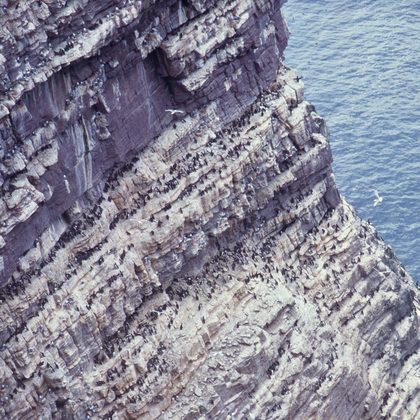
Outside the breeding season at sea, from the inshore zone to well out on the shelf, locating and following shoals of herring, mackerel and sprat; it gathers readily behind trawlers. Breeds in dense colonies on steep island cliffs and sea stacks, with nests spaced exactly one bill-length apart. The Netherlands has seen small breeding attempts on an offshore platform and at the Maasvlakte in recent years, but the great colonies lie elsewhere.
Where the bird is most at home, classified with EUNIS — the European standard for habitats.

Range and movements
Breeds in Scotland (Bass Rock being the largest colony in the world), Wales, Ireland, Iceland, the Faroes, Norway, Brittany and on Heligoland. Present on the Dutch North Sea year-round, with the highest inshore numbers from August to November and after winter gales. In Spain tens of thousands winter in the Bay of Biscay, off Galicia and along the Portuguese and Andalusian coasts; large numbers pass through the Strait of Gibraltar in autumn into the Mediterranean, where the species winters as far as Catalonia.
- Resident
- Breeding (summer)
- Winter
- Passage
- Migration direction
- dark = core range, pale = thinly spread
Where and when to look
Seawatching on a north-westerly in October and November gives the highest Dutch counts; Westkapelle, the Brouwersdam and IJmuiden are the best stations, and juveniles often dominate in September. Try a pier in an offshore wind too: parties then sometimes fish within a few hundred metres. In Spain the Strait of Gibraltar is spectacular from October to December, with thousands a day from Tarifa, while Estaca de Bares in Galicia produces birds steadily all winter. A visit to Bass Rock or Heligoland in June supplies the whole story, sound included.
Conservation status
Not threatened, and until recently one of the few seabirds increasing steadily in north-west Europe; colonies in Scotland, Norway and on Heligoland grew for decades. The avian influenza outbreak of 2021 to 2023 hit the species hard: thousands died on Bass Rock and in other major colonies and breeding success collapsed temporarily. Bycatch in longline fisheries, entanglement in net debris collected as nest material, and oil pollution also play a part. Recovery from the influenza appears to be under way, but the consequences have not yet played out.