All species › Birds of prey › Hawks, eagles and kites › Montagu's harrier
Montagu's harrier
Circus pygargus | Grauwe kiekendief | Aguilucho cenizo
Montagu's Harrier is the most elegant of the three: so lightly built that over a cereal field it seems to float rather than fly. In the Netherlands it has become the emblem of farmland bird conservation, because virtually the whole Dutch population nests in crops on the arable land of Groningen and Flevoland.

Voice
Silent away from the nesting area. Around the nest a fast, high, slightly rattling kek-kek-kek, thin and nasal, distinctly higher than the Hen Harrier's. The female begs at food passes with a drawn-out, plaintive pee-yeh, and that call over a cereal field often gives the nest site away. On migration and away from the breeding grounds the species is not heard.
No freely licensed recording is available for this species yet.
Identification
Slim, long-winged and long-tailed, with a light, buoyant wingbeat and the wings held in a clear V. The wing is pointed and shows only four fingered primaries, so the tip looks narrower than a Hen Harrier's. Male: slate-grey on head, breast and upperparts, with a black bar across the secondaries of the upperwing — the species' best mark — and two black bars across the underwing. The belly is white with fine rusty streaks on the flanks and undertail coverts, the wingtip is extensively black but merges into the grey rather than contrasting sharply with it, and the rump is grey with at most a narrow pale edge. Female: brown and streaked, with a barred tail, a small narrow white rump patch and a finely barred inner underwing. Juvenile: warm rufous and unstreaked below, with a dark face mask, an incomplete pale collar and a dark, double-barred inner underwing.
Confusion species
Separating Hen, Pallid and Montagu's is the classic exercise. The male Montagu's is identified by the black bar across the upperwing secondaries and the two black bars on the underwing; neither Hen nor Pallid has them. It is also slimmer, sharper-winged and darker grey than a Hen Harrier, with a black wingtip that fades into the grey rather than cutting sharply against it, and with rusty flank streaks. Against Pallid it looks darker and less white, with a broader black hand. On females and juveniles the head and inner underwing decide it: Montagu's has an incomplete collar, open at the front, and a dark, double-barred central panel on the inner underwing, where Pallid has a closed collar and a strikingly pale, unbarred panel. Hen Harrier is bulkier and broader-winged, with five fingered primaries and a much larger white rump. At long range the flight helps: Montagu's flaps more loosely and elastically, almost like a tern.
Habitat
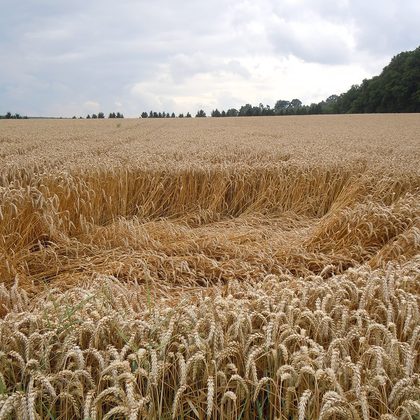
Originally a bird of marsh, dunes, raised bog and steppe; in western Europe it has largely switched to arable land and now nests in winter wheat, barley and lucerne. It forages over herb-rich field margins, set-aside strips and verges, hunting voles, young birds and large insects. It nests on the ground, usually in loose colonies, so that in an early harvest its breeding success depends entirely on protection measures.
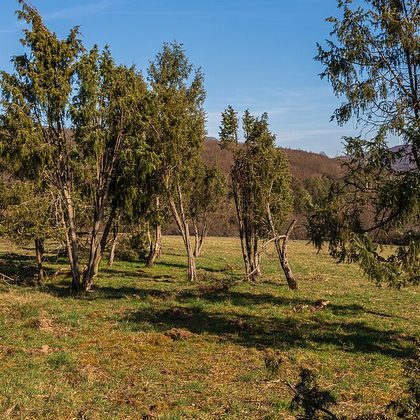
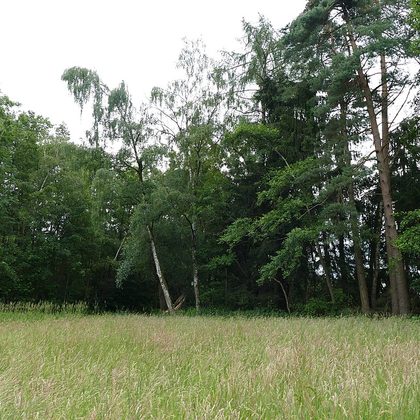
Where the bird is most at home, classified with EUNIS — the European standard for habitats.
Range and movements
Breeds across most of Europe, with strongholds in Spain, France, Poland and Russia, and winters in the Sahel and East Africa. The Dutch population runs to a few dozen pairs, concentrated in the arable districts of eastern Groningen, the Flevoland polders and south-west Friesland, where volunteers find the nests and fence protected zones around them. In Spain the species is far more numerous: thousands of pairs on the cereal plains of Castile, Extremadura and Andalusia, where the early grain harvest poses exactly the same threat.
- Breeding (summer)
- Winter
- Passage
- Migration direction
- dark = core range, pale = thinly spread
Where and when to look
In June or July drive the arable districts of eastern Groningen or the Flevoland polders and work the wide, herb-rich field margins. Birds are most active early in the morning and in the last hours before sunset, and with luck you will see an aerial food pass: the male drops a vole, the female rolls over and takes it. In Spain a quiet road across the cereal plains of Extremadura in May is enough; in places they outnumber Buzzards there.
Conservation status
Not globally threatened (IUCN: Least Concern), but in western Europe heavily dependent on human help. Because it nests in crops that are harvested before the young fledge, breeding success rests on finding and protecting nests. Agricultural intensification, the loss of fallow and crashes in vole numbers are pushing numbers down; in the Netherlands targeted farmland management keeps the small population going. The European trend is slightly negative, with the main losses in the south and east.