All species › Woodpeckers and allies › Woodpeckers › Middle spotted woodpecker
Middle spotted woodpecker
Dendrocoptes medius | Middelste bonte specht | Pico mediano
The Middle Spotted Woodpecker is the woodpecker of old oak forest: a slightly smaller, rounder cousin of the Great Spotted, with an all-red crown and a plaintive wailing call instead of a drum roll. It only settled in the Netherlands around the turn of the century and is still spreading.

Voice
The display call is the great find of early spring: a slow, nasal, plaintive kwaaeh-kwaaeh-kwaaeh, like a cat wailing high in an oak, repeated four to eight times and falling in pitch. The contact call is a soft, flat kuk, far less sharp and explosive than the kik! of Great Spotted. It drums rarely and feebly: a short, quiet, slightly irregular burst of under a second, whereas Great Spotted produces a hard, evenly paced roll of well over half a second that sounds higher and drier.
Recording: Jesús Lavedán Rodríguez — CC BY-SA 4.0 · Wikimedia Commons
Identification
Slightly smaller and plumper than Great Spotted Woodpecker, with a short, rather weak bill better suited to probing than chiselling. Both sexes have a red crown — brighter and more extensive on the male, duller pinkish-red on the female — and that red runs back over the head with no black border. The face therefore looks strikingly white and open: the black moustachial stripe starts below the eye, never touches the bill base and never reaches the nape. The flanks are cream with fine dark streaks and the vent is pale salmon-pink rather than scarlet. Juveniles already resemble the adults but are duller, with a matt crown and a browner cast.
Confusion species
Great Spotted Woodpecker is bigger and more angular, with a heavy chisel bill, a crisp black-and-white head pattern in which the black moustache runs unbroken to the nape, plain white flanks and a vivid red vent; males show only a red nape patch, females no red at all. The real trap is the juvenile Great Spotted, which wears a full red cap in June and July. Look at the framing: on the juvenile the red cap is edged with black and a black band from the moustache to the nape cuts the white face into pieces, while Middle Spotted keeps an open white face with the red fading out behind. The juvenile's heavier bill and scarlet vent give it away too. Lesser Spotted Woodpecker is far smaller, with a barred back and never any red under the tail.
Habitat
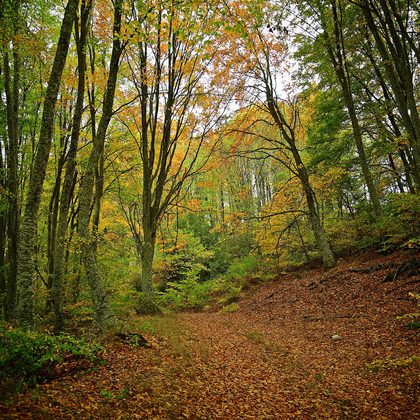
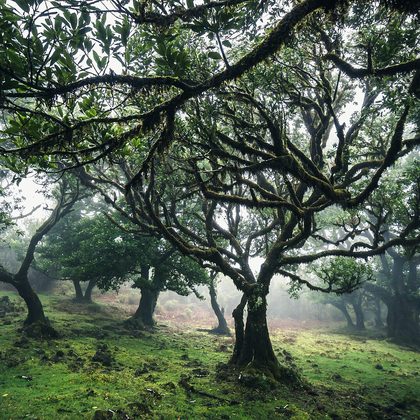
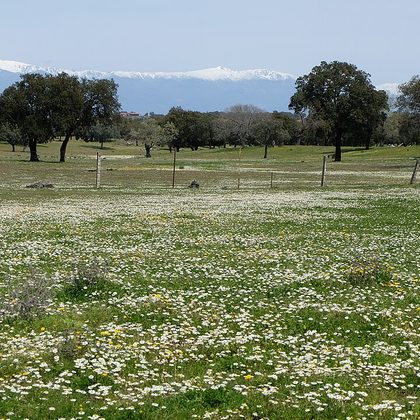
Old, structurally rich broadleaved woodland with plenty of rough, deeply fissured bark: oak above all, plus hornbeam, old ash and orchards of gnarled standard trees. It forages by searching and probing in the canopy and along thick limbs, hammering far less than other woodpeckers, so it needs mature trees rather than young smooth-barked stands. Further south it favours old cork oak woodland and dehesa-like oak pasture.
Where the bird is most at home, classified with EUNIS — the European standard for habitats.
Range and movements
From northern Spain and France east to Poland, the Balkans and the Caucasus, with its stronghold in central and eastern Europe. The Netherlands long lay outside the range: the first pairs settled in southern Limburg in the 1990s, after which the species spread through Brabant, the Achterhoek and Twente and now breeds at dozens of sites. In Spain it is a bird of the old oak and beech woods of the Cantabrian mountains and the Pyrenees, with isolated populations further south in mature cork oak.
- Resident
- Breeding (summer)
- Winter
- Passage
- Migration direction
- dark = core range, pale = thinly spread
Where and when to look
March and the first half of April, in an old oak wood just after sunrise. Stand still and listen for the wailing kwaaeh; drumming will not help you here, because almost all of it is Great Spotted. Follow the sound and look high in the canopy, where the bird shuffles slowly along thick branches. In the Netherlands the old oak woods of southern Limburg, the Rijk van Nijmegen and the Achterhoek are the best addresses.
Conservation status
Not threatened (IUCN: Least Concern) and in fact advancing in western Europe: the European population is increasing and the range is shifting north-west, helped by forests being allowed to age and by more standing deadwood. The species remains wholly dependent on old rough-barked oaks, however; conversion to young production forest or the removal of old, failing trees makes it disappear at once.