All species › Passerines › Reed warblers › Melodious warbler
Melodious warbler
Hippolais polyglotta | Orpheusspotvogel | Zarcero común
The southern counterpart of the Icterine Warbler: a shade smaller, rounder and shorter-winged, with a rattling, sparrow-like babble instead of a hurried medley. In Spain and southern France it is one of the commonest scrub birds, and its northern limit has been creeping up through France for decades.

Voice
The song is a fast, low, rattling babble most like an excited House Sparrow: a sustained stream of short grating and chattering notes at high speed, kept up for minutes on end from deep inside a bush. Unlike Icterine it completely lacks the nasal de-de-roid, and the whole delivery is flatter, more even and less shrill. The call is a dry, sparrow-like tret-tret-tret and a short teck. Song from late April into July, including the middle of the day.
Recording: Benoît Van Hecke — CC BY-SA 4.0 · Wikimedia Commons
Identification
Olive-brown above and soft yellow below, round-headed and compact. The wing formula decides it: the primary projection is short, at most half the exposed tertials, which makes the wing look blunt and the tail long. The pale wing panel shown by Icterine is usually absent, or at best a vague pale edging. The legs are brown-grey to fleshy brown rather than blue-grey, and the bill is broad with an orange lower mandible.
Confusion species
Icterine Warbler is the key confusion species: longer primary projection (about equal to the tertials), an obvious pale wing panel, blue-grey legs, greener and greyer plumage and a more angular head. Western Olivaceous Warbler, in southern Spain, is greyer with almost no yellow and constantly dips its tail. Willow Warbler is smaller, finer-billed and has a sharp supercilium.
Habitat
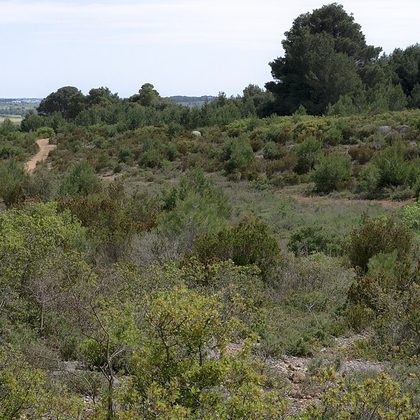
Low dense scrub: bramble and thorn along rivers, unkempt hedges, maquis and garrigue, olive groves with an understorey, gardens and road verges. It likes warm sunny slopes and chooses bushes it can sing from unseen, where Icterine seeks an open twig.
Where the bird is most at home, classified with EUNIS — the European standard for habitats.




Range and movements
Iberia, France, Italy and north-west Africa. Common and widespread in Spain, from river valleys up into the lower mountains. The boundary with Icterine Warbler runs straight through France and Belgium and is slowly shifting north; in the Netherlands the species is a rare visitor in May and June, with the occasional singing male and a very occasional breeding attempt. Winters in West Africa south of the Sahara.
- Breeding (summer)
- Passage
- Migration direction
- dark = core range, pale = thinly spread
Where and when to look
In Spain in May, mid-morning, along a river or a rank field edge with brambles. Do not look up but at the bush itself: the rattling babble usually comes from a dense clump at eye level, and the bird often shows only as it flicks to the next bush. In the Netherlands, any long-singing 'Icterine' that never gives the de-de-roid is worth checking.
Conservation status
Not threatened, stable to slightly increasing in Europe and clearly pushing north in France. Loss of riverside scrub, hedge clearance and the burning of maquis hurt it locally, but neglected plots and abandoned fields hand it new habitat.