All species › Passerines › Tits › Marsh tit
Marsh tit
Poecile palustris | Glanskop | Carbonero palustre
The Marsh Tit is the tit of old, dry broadleaved woodland, and the counterpart to Willow Tit in the hardest identification problem Europe's tits have to offer. Its Dutch name says exactly what to look for: gloss on the cap. Its call says it more plainly still.

Voice
The decisive mark. The call is an explosive, hard, sharp pitchou — a two-syllable slap, short and loud, as if something has snapped — often followed by a run of nasal tchay-tchay-tchay. Willow Tit has no such explosive attack; its call is slow and plaintive. The song is a fast, metallic rattling chip-chip-chip-chip on one note, alongside a variant of clear descending whistles. Heard all year, peaking from February to April. In a mixed flock, pitchou is almost always the first clue that the species is present.
Recording: Alexander Kürthy — CC BY-SA 4.0 · Wikimedia Commons
Identification
A small brown tit with a trim, neat outline: a proportionally small head, a slim neck and smooth, close-lying plumage. The cap is glossy blue-black and stops sharply on the nape along a clean edge. The bib under the chin is small and neatly bounded, a tidy black patch that does not spread. The cheeks are pure white along their whole length, with no buff wash at the rear. The wing is uniform grey-brown: there is no pale panel on the secondaries. On the cutting edge of the upper mandible there is often a small pale spot, a good mark on a close bird. Flanks are pale buff-brown, duller than a Willow Tit's.
Confusion species
Willow Tit, and really nothing else — see its species page, where the same distinction is set out from the other side. Willow Tit has a dull matt-black cap running well down the nape, a large ragged bib with a vague lower edge, cheeks that turn buff behind, a clear pale panel on the secondaries, a thicker neck and a larger head, and no pale spot on the bill. In photographs and poor light those differences vanish; only the voice is truly watertight. Coal Tit has a white nape patch and white wing bars, Crested Tit a crest, Great Tit yellow underparts with a belly stripe.
Habitat
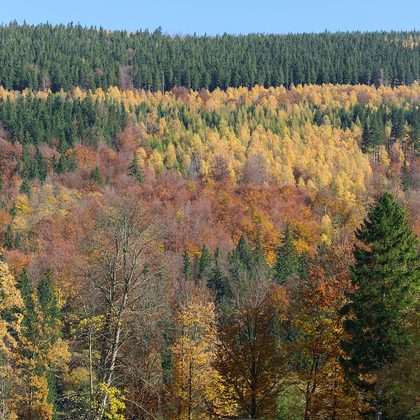
Older, closed broadleaved woodland on drier ground, with beech, oak, ash and old hedgerows; across Europe its range follows that of beech fairly closely. It needs continuous woodland of at least a few hectares and avoids young plantation and fragmented parcels. Also estate woods, parks with old trees and occasionally a well-wooded garden. Nests in existing cavities in dead or living wood, enlarging them a little in rotten timber, and uses nest boxes only rarely. Caches food in autumn across hundreds of separate hiding places.
Where the bird is most at home, classified with EUNIS — the European standard for habitats.


Range and movements
From Britain and northern Spain to eastern Europe and, in a separate population, East Asia. In the Netherlands a fairly common resident of the old broadleaved woods on the sandy soils, the country estates and South Limburg, with 14,000 to 17,000 pairs in 2018–2020; it expanded northwards until about 1990, for instance into western Drenthe. In Spain it is rare and very local, confined to the far north, in the beech and oak woods of the Pyrenees and the humid mountain forests of the Basque Country and Navarre.
- Resident
- Breeding (summer)
- Winter
- Passage
- dark = core range, pale = thinly spread
Where and when to look
Enter an old beech wood or estate woodland in February or March, stand still where the flock passes and wait for the explosive pitchou. The most efficient way to learn both species is to visit two sites in one day: a dry, old beech wood for Marsh Tit and a damp alder or willow carr for Willow Tit, recording only on voice in each. In winter it is a regular member of mixed tit flocks, and it visits feeders near old woodland, carrying seed away to cache it.
Conservation status
Not globally threatened. In the Netherlands numbers have held steady in recent decades and the species suffers little in hard winters, a striking contrast with the steep decline of Willow Tit. In Britain and parts of central Europe it is declining, chiefly through the loss of coppice and shrub layer and the fragmentation of old broadleaved woodland. Keeping old woodland continuous and rich in cavities is the heart of its conservation.