All species › Tubenoses › Petrels and shearwaters › Manx shearwater
Manx shearwater
Puffinus puffinus | Noordse pijlstormvogel | Pardela pichoneta
The Manx Shearwater is the commonest shearwater of north-west Europe and the textbook example of shearing: it banks so low over the swell that a wingtip almost touches the water, flashing alternately black and white. Britain and Ireland hold very nearly the entire world population.

Voice
Silent at sea. At the colony at night it produces one of the strangest sounds in Europe: a hoarse, screeching, retching three-part cry, coo-cooroo-ah, given from the burrow and in flight in the dark, and the reason the bird is called Devil Bird in the Celtic countries. Audible from April to August on Skomer, Skokholm, Rum and the Irish west-coast islands; over Dutch waters the species stays mute.
Recording: British Library — CC BY-SA 4.0 · Wikimedia Commons
Identification
A medium-sized, slim shearwater with narrow, straight, fairly stiff wings and a short tail. The flight makes the impression: a few fast stiff beats and then a long glide in which the bird tips onto its side, showing first the black upperparts and immediately afterwards the white underparts, so that it blinks its way across the waves. Above it is uniform blackish-brown, below clean white, with a sharp division that runs right below the eye. The white extends up behind the base of the wing, creating a white notch into the dark flank. The underwing is white with a narrow dark trailing edge and dark tip; the undertail coverts are white. Bill thin and dark, legs pink.
Confusion species
Yelkouan Shearwater is the key confusion species and the separation rests on the underparts: in Manx the belly, underwing and undertail are clean white with a crisp border, in Balearic they are dirty white to brownish, with dark axillaries, dark undertail coverts and a smudged, ill-defined border on the neck. Balearic is also more heavily built, with a fuller belly, broader wings and a less elegant, more flapping flight that stays lower to the water. Yelkouan Shearwater, in the Mediterranean, sits between the two, with white undertail coverts but browner upperparts. Razorbill and Guillemot fly on whirring, continuous beats without glides and have a more compact, neckless outline. Little Auk is much smaller and darker.
Habitat
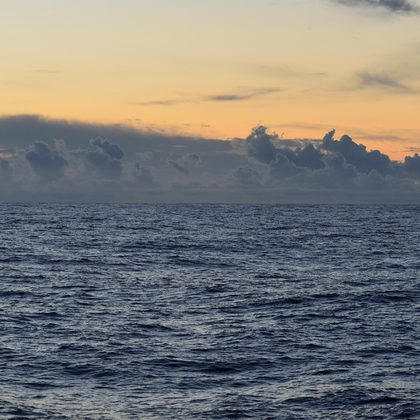
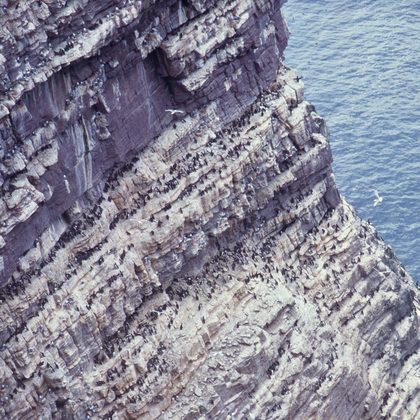
Outside the breeding season entirely marine, over the continental shelf and along shelf edges, diving after sandeels, sprat and herring and often rafting on the water in flocks. Breeds colonially in self-dug burrows on grassy slopes of rat-free islands, visiting the colony only in darkness to escape predation by large gulls. Winters off the coasts of Brazil and Argentina.
Where the bird is most at home, classified with EUNIS — the European standard for habitats.
Range and movements
Breeds in Britain, Ireland, Iceland, the Faroes, Norway, Brittany and on the Azores and Madeira, with by far the greatest part of the world population on Skomer, Skokholm and Rum. The Netherlands has no colonies; on the North Sea it is a regular migrant from April to October, with the highest numbers on north-westerly winds in August and September. In Spain it is numerous along the Cantabrian and Galician coasts and through the Strait of Gibraltar, where thousands pass in spring and autumn.
- Resident
- Breeding (summer)
- Winter
- Passage
- Migration direction
- dark = core range, pale = thinly spread
Where and when to look
In the Netherlands, seawatch on a north-westerly in August or September from Westkapelle, the Brouwersdam or IJmuiden, and watch for the characteristic black-and-white blink as the bird banks; in calm weather you will hardly see one. In Galicia, Estaca de Bares or Cabo Home in September yields hundreds in a morning. The Strait of Gibraltar in March and April is spectacular: from Tarifa or Punta Carnero, easterly winds push large flocks close inshore into the Mediterranean, which is also the best chance to compare Manx and Balearic side by side.
Conservation status
Not threatened; the world population is estimated at well over a million birds and the large British and Irish colonies are stable or growing. The main threats are introduced rats and cats on breeding islands and light pollution, which disorientates fledglings; on Madeira and the Azores that is a real problem. Rat eradication on islands such as Lundy and Ramsey has produced a clear increase in breeding pairs.