All species › Gamebirds › Pheasants and partridges › Lady Amherst's pheasant
Lady Amherst's pheasant
Chrysolophus amherstiae | Lady amherstfazant | Faisán de Lady Amherst
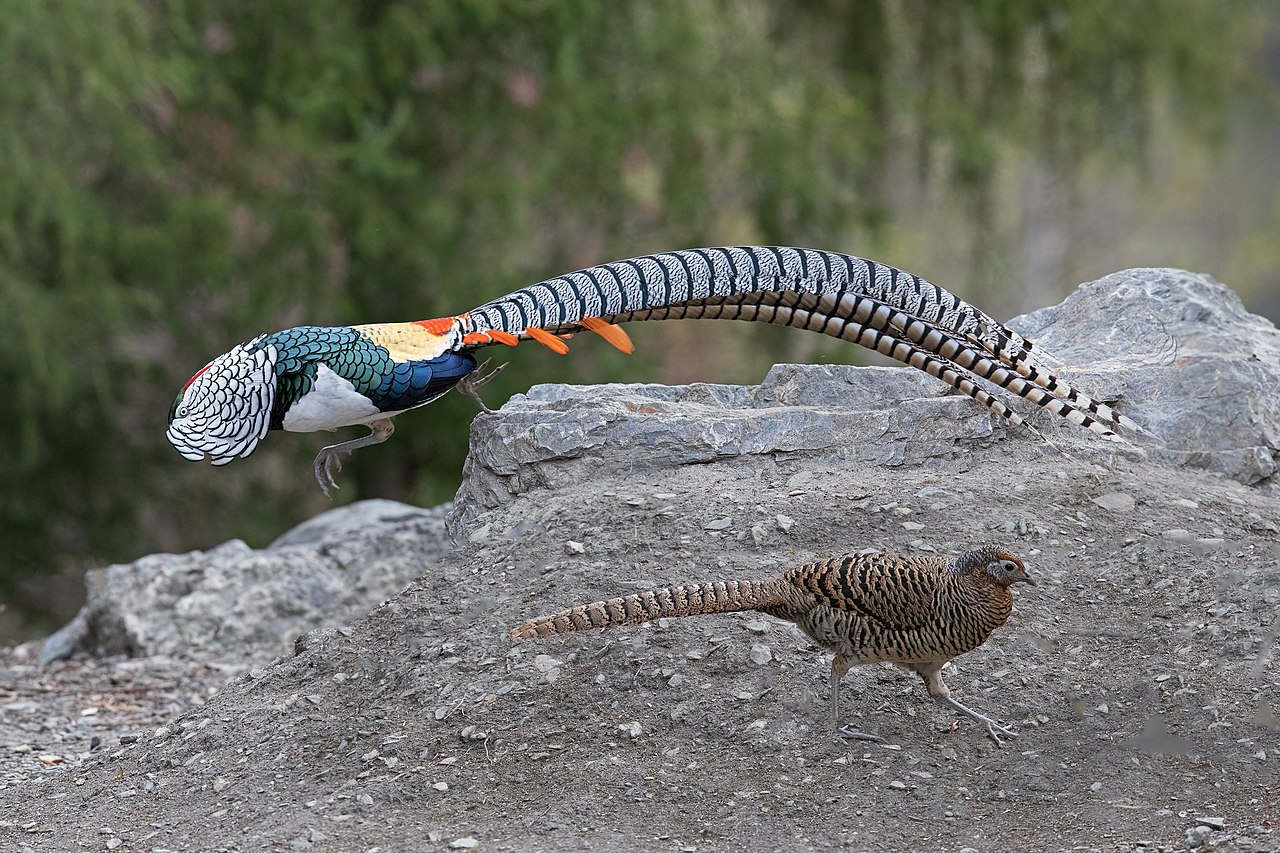
A pheasant in black, white and bottle green, trailing a barred tail like a whip. Native to the mountain forests of south-west China and northernmost Myanmar, in Britain it was the birder's holy grail among introduced birds. It is now gone: the last accepted bird was a single cock in Bedfordshire in 2015.
Voice
In spring the cock gives a hard, metallic, usually two-part chack-chack, much shorter and drier than a Pheasant's crow and with something of two stones struck together. In display, spreading the cape into a collar and circling the hen sideways, he adds a short hissing shoo. Outside April and May the bird is silent, and the voice cannot be separated from Golden Pheasant's.
No freely licensed recording is available for this species yet.
Identification
The cock is 100–120 cm long, some 80 cm of that a broad, gently curved tail, white with crisp black bars. On the nape he wears a cape of white feathers edged black, above it a small red crest, with a dark green mantle scaled black, snow-white underparts, a yellow rump tipped red and orange-red tail coverts. The hen is 60–68 cm, rufous brown and coarsely barred, with blue-grey legs and bare blue-grey skin around the eye.
Confusion species
Against Golden Pheasant the cock is easy: white below rather than red, a black-and-white scaled cape rather than an orange ruff, and a broad black-and-white barred tail rather than a narrow ochre one. The hybrids are the difficulty. In Bedfordshire and Buckinghamshire the two lived side by side for decades and interbred freely, and red bleeding onto the belly or flanks, an orange wash over the cape feathers, or an intermediate crest and tail all point to mixed stock; pure birds became scarce. The hens are the hardest problem of all. Lady Amherst's hen is more rufous and more coarsely barred than a Golden hen, with blue-grey legs and a bare blue-grey eye-ring against the Golden hen's yellow legs. Both are routinely written off as Pheasant hens, but both are smaller, barred from head to belly rather than blotched, and finer-tailed.
Habitat
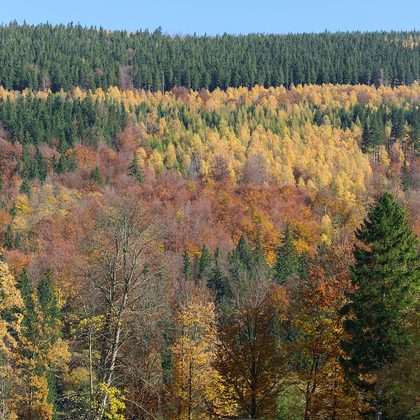
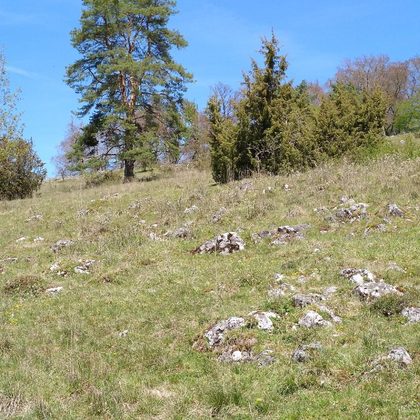
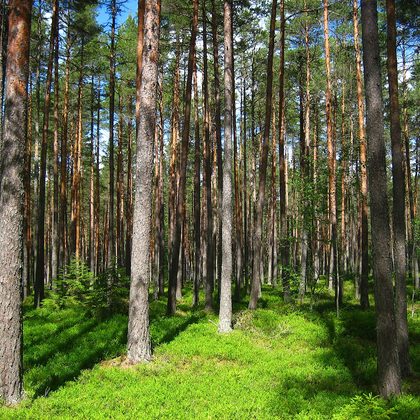
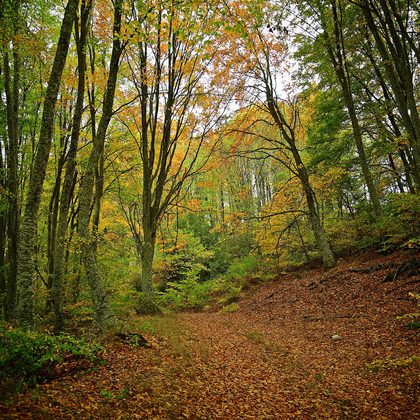
Deciduous or mixed woodland with a dense, dark understorey, almost always rhododendron, or unbrashed stands of mid-growth conifer. In China, bamboo and shrubby montane forest between 2,000 and 3,600 m, much higher than Golden Pheasant. The bird spends the day walking through cover, feeding on rides and small clearings, and roosts in trees.
Where the bird is most at home, classified with EUNIS — the European standard for habitats.
Range and movements
Native to south-west China, chiefly Sichuan and Yunnan, and to extreme northern Myanmar. Released in the 1890s at Woburn Abbey in Bedfordshire and on the Isle of Bute, with small later nuclei in north Wales. The species proved extraordinarily sedentary, unwilling to cross open ground on foot or on the wing, and spread little more than ten kilometres from the release sites in a century. Every recent bird elsewhere in Europe is an escape.
- Winter
- Passage
- dark = core range, pale = thinly spread
Where and when to look
There is nothing left to look for. The last reliable British bird was a lone cock near Lidlington on the Greensand Ridge in Bedfordshire, watched from the footpath along the Millbrook proving-ground fence and last seen in 2015; appearances were always brief and unpredictable. Any bird found now is almost certainly an escape, so check for rings on both legs and for unworn, aviary-fresh plumage. For the real thing, the montane forests of northern Yunnan and western Sichuan in April and May.
Conservation status
Not globally threatened; the Chinese population is large and spread over many ranges. In Britain the self-supporting population in south Bedfordshire and east Buckinghamshire held 100–200 pairs at its peak around 1970, was down to some forty pairs by the turn of the century, and then collapsed. The species sits in Category C6 of the British List, for naturalised birds whose populations are extinct. The reasons given are loss of understorey, partly through browsing by introduced Muntjac, fox predation, inbreeding in a population that never spread, and the end of restocking.