All species › Waders, gulls and terns › Gulls and terns › Forster's tern
Forster's tern
Sterna forsteri | Forsters stern | Charrán de Forster
A Nearctic tern that reaches this side of the Atlantic in ones and twos and, unusually for a vagrant, stays. Britain and Ireland hold most of the European records, several of them birds that wintered on a single estuary and came back the following year.

Voice
Low, nasal and grating: a short, hard kyarr or zaaarr, clearly lower and drier than the shrill kee-yah of Common Tern and without the bright, high note of Arctic. In flight it also gives a short, dry kit. A wintering vagrant is usually silent, but a bird working its way along a line of posts will call sooner or later, and when it does the matter is closed.
Recording: Jonathon Jongsma — CC BY-SA 3.0 · Wikimedia Commons
Identification
Slightly bulkier than a Common Tern, with longer legs, a heavier bill and a longer, deeply forked tail. In breeding plumage it has a black cap, an orange bill with a black tip and pure white underparts without the grey wash of Common Tern; the upperwing is pale with strikingly silvery-white primaries that look paler than the mantle. In winter plumage, which is what almost every European bird has shown, the crown is white to pale grey and a compact black mask sits over and behind the eye without reaching the nape. The bill is then black, the legs orange-red and fairly long. The outer tail feathers are grey rather than white, and on a settled bird the tail projects beyond the wingtip. The length quoted includes those streamers.
Confusion species
The head does the work, and the bird to beat is a winter Common Tern. On Common Tern the black starts just in front of the eye and runs back across the rear crown into the nape, forming an unbroken dark band round the back of the head with a white forehead in front of it. On Forster's the black sits as a discrete, sharply defined patch over and behind the eye, with a white to pale grey crown and a white nape around it: a mask, or a black comma, floating free in white on both sides. The second character is the wing. Forster's shows a pale, silvery primary panel that looks lighter than the mantle, and it lacks the dark carpal bar that a winter or juvenile Common Tern carries along the forewing; on Common Tern the hand is the darkest part of the upperwing, on Forster's it is the palest. Beyond that, Forster's is longer legged, heavier billed and longer tailed, with grey rather than white outer tail feathers, and the underparts are white without a grey wash, which also rules out Arctic Tern. At range the combination of pale outer wing and isolated black eye patch stays the most reliable; if the bird calls, the low, nasal, grating note confirms it.
Habitat
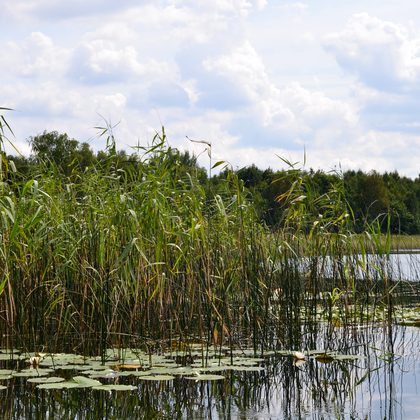
In North America a marsh bird, nesting in loose colonies on floating mats of reed and cattail in fresh and brackish marshes, on saltmarsh and around the edges of shallow lakes. Outside the breeding season it is entirely coastal: estuaries, tidal creeks, harbours, lagoons and sandflats. It feeds by hovering and plunging over shallow water and also picks insects from the surface, which Common Tern does far less. European birds have almost always settled on an estuary or in a harbour and stayed put, sometimes for months.
Where the bird is most at home, classified with EUNIS — the European standard for habitats.



Range and movements
Breeds across interior North America from the Canadian prairie provinces to the Great Plains, with coastal populations on the Atlantic seaboard, the Gulf of Mexico and in San Francisco Bay, and winters along the southern coasts of the United States into Central America. In Europe it is a vagrant, with the bulk of records in Ireland and Britain, mostly on the south and west coasts and mostly in winter. Long-staying individuals have held a single harbour or estuary for a whole winter and returned in successive years, so the same bird can account for several seasons of records.
Where and when to look
Work the winter, not the summer. From November to March any tern still on the coast is worth a look at the head, and that is a short enough list to check properly: harbours, estuary mouths, marina pontoons and the pier heads where gulls loaf. Take the head pattern first and the wing second, because a distant winter Common Tern gives the same first impression. Long-stayers return to favourite perches, so once a bird is found it is usually findable again on the next tide.
Conservation status
Least Concern; the North American population is large and spread across many wetlands. Regionally it is under pressure where saltmarsh and freshwater marsh are being lost, San Francisco Bay being the best documented case, where mercury contamination of the breeding marshes comes on top of habitat loss. None of that drives the European picture, which is simply a matter of how many birds cross with westerly weather systems and how many of them go unnoticed among wintering Common Terns.