All species › Birds of prey › Hawks, eagles and kites › European honey-buzzard
European honey-buzzard
Pernis apivorus | Wespendief | Abejero europeo
The Honey-buzzard is the last summer visitor to arrive and the first to leave: mid-May to late August, and the rest of the year in Africa. It digs out wasp nests with its feet, and with its scaly head feathering and buzzard-like look it is one of Europe's best-disguised raptors.

Voice
Away from the territory it is almost always silent, and never heard on migration. Over the breeding wood it gives a clear, two-syllable, slightly plaintive whistle, pee-looo or pee-eh, higher, shorter and purer than the Buzzard's drawn-out mewing, mainly in May and June during display. That display is in fact the species' best mark: high over the wood the bird rises, hangs, then claps its wings rapidly above its back several times, as if applauding.
Recording: Benoît Van Hecke — CC BY-SA 4.0 · Wikimedia Commons
Identification
A Buzzard at range, nothing of the sort close up. Four differences do the work. First the head: small, narrow and pigeon-like, on a slender neck that lets it project well forward — a Buzzard's head sits short and broad against the body. Second the tail: long and narrow, with two narrow dark bars near the base and one broad black band at the tip, and a wide pale zone between them; a Buzzard has a short fanned tail with many narrow bars. Third the wing attitude: in a glide the Honey-buzzard holds its wings flat or slightly drooped, with the primaries bowed down, where the Buzzard holds them in a shallow V. Fourth the wing shape: longer, narrower and pinched at the base, with a pronounced bulge in the trailing edge. Plumage varies enormously, from near-white to near-black, but the primaries almost always carry a broad black tip and the underwing shows coarse, widely spaced bars. The adult's eye is bright yellow, the male's head slate-grey.
Confusion species
The Common Buzzard is the comparison, and the four marks above — small projecting head, long tail with two narrow bars and one broad one, flat or drooped wings, pinched wing base — work together far more reliably than any one alone. Watch the wingbeat too: the Honey-buzzard flaps deeper, more supple and looser, almost crow-like, where the Buzzard is stiffer and shallower. Juvenile Honey-buzzards look most Buzzard-like, with a dark bill base, a dark eye and less clearly banded tail; then go by head shape and wing base. A pale Honey-buzzard can also suggest an Osprey from below, but that bird has a far whiter body, kinked wings and a dark carpal patch. Finally, a dark Honey-buzzard can recall a Black Kite, which however has a forked tail and a much more restless, rocking flight.
Habitat
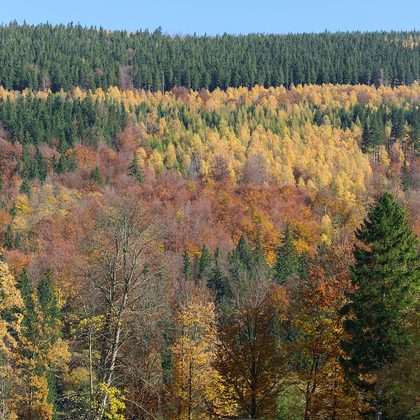
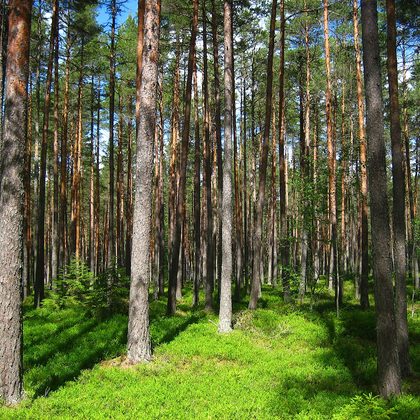
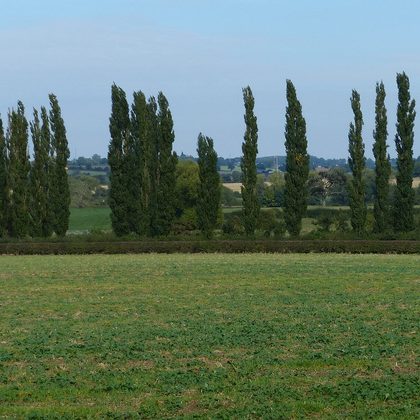
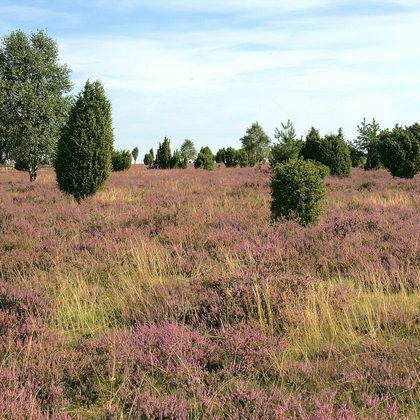
Extensive, varied mature woodland with clearings, clear-fell, wide rides and adjoining heath or grassland — exactly where ground wasp nests are found. It breeds in broadleaf or conifer woodland, often in an old nest of another raptor or a crow. It forages largely on foot or by digging on the ground, scooping wasp and bumblebee grubs out of the nest with its feet, and also takes frogs, young birds and fruit.
Where the bird is most at home, classified with EUNIS — the European standard for habitats.

Range and movements
Breeds across almost all of temperate Europe, from Spain deep into Russia, and winters in the tropical forests of West and Central Africa. In the Netherlands it is a scattered breeder of the wooded sandy soils — Veluwe, Drenthe, Utrechtse Heuvelrug, Brabant and Limburg — with a few hundred pairs. In Spain it breeds in the northern forests from Galicia to the Pyrenees and passes over the Strait of Gibraltar in enormous numbers; tens of thousands go through at Tarifa in May and September.
- Breeding (summer)
- Passage
- Migration direction
- dark = core range, pale = thinly spread
Where and when to look
Migration is the moment. In the second and third weeks of May, or between late August and mid-September, take a watchpoint or open viewpoint on a fine day with a light easterly and watch for parties drifting through on thermals. To see a breeding bird, choose a warm, windless June morning overlooking a large block of forest and wait for the wing-clapping display; that is the one time the species really shows itself. In Spain, Tarifa in May is unmatched.
Conservation status
Not globally threatened (IUCN: Least Concern), but the European trend is slightly negative. Dutch numbers have roughly halved in recent decades; cooler, wetter summers reduce the supply of wasps, and forest fragmentation, disturbance and losses to hunting on migration in southern Europe and the Middle East all play a part. Quiet around nest sites, and forestry that keeps clearings and herb-rich edges open, help this species most.