All species › Passerines › Larks › Eurasian Skylark
Eurasian Skylark
Alauda arvensis | Veldleeuwerik | Alondra común
The songbird of open fields, hanging on quivering wings and singing for minutes on end until it is no more than a speck. Its song was once the automatic background music of every farmed landscape.
Voice
An unbroken, rapid stream of chirruping, rolling and whistled motifs, sustained for minutes during the hovering song flight and often including mimicry. Sings from February to July, very high up and sometimes before sunrise. The flight call is a dry rolling chirrup, also heard on winter movement days.
Recording: Marie-Lan Taÿ Pamart — CC BY-SA 4.0 · Wikimedia Commons
Identification
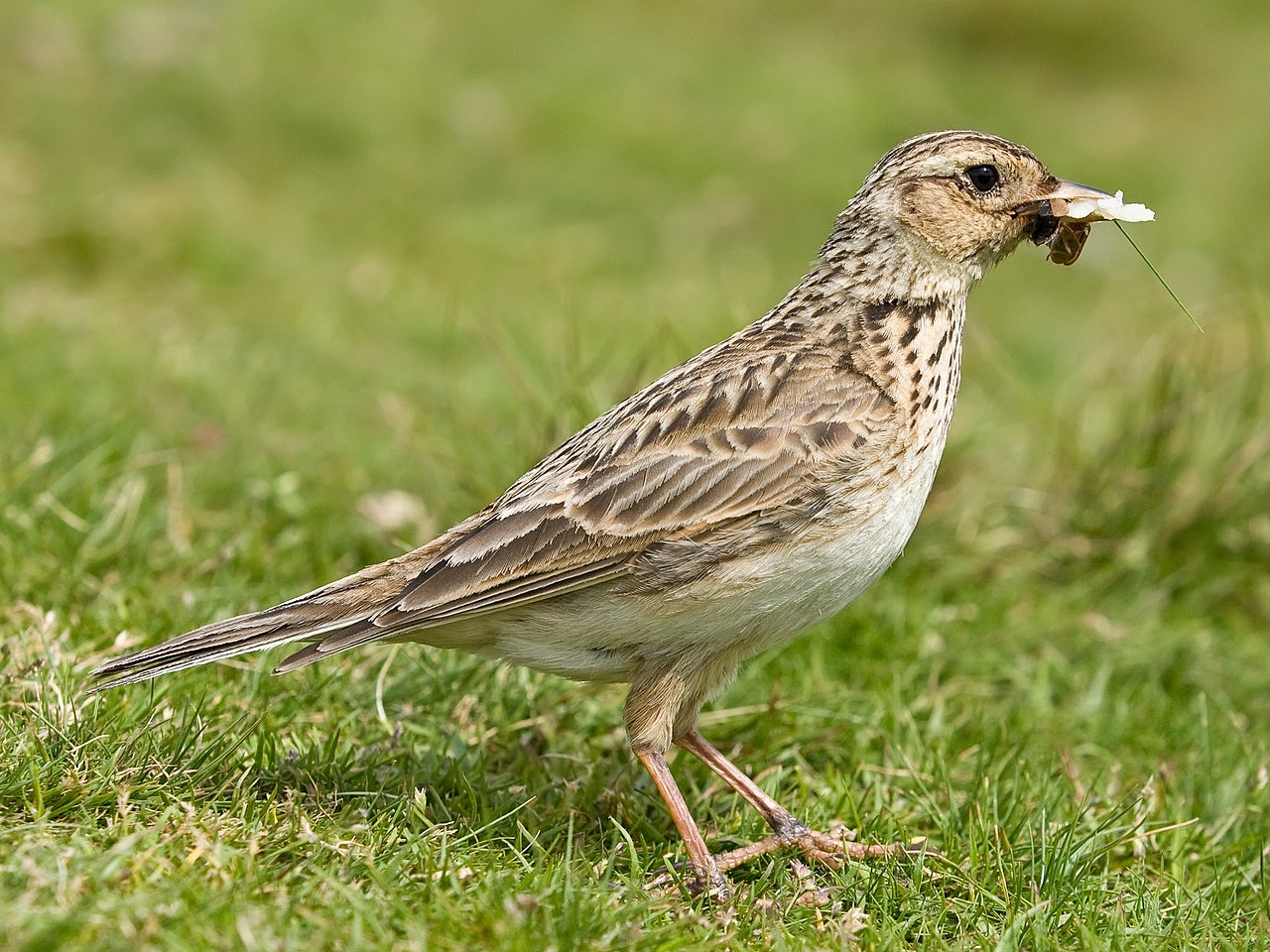
A sturdy, earth-coloured lark with a short erectile crest, a fairly long tail with white outer feathers and a narrow white trailing edge to the wing. Streaked brown above, creamy with fine streaks across the breast and an unmarked belly. Walks low and fast on the ground; flies with irregular, hesitant beats and short glides.
Confusion species
Woodlark is shorter-tailed, with a bold white supercilium meeting on the nape, a black-and-white mark at the bend of the wing and no white in the tail, and sings a descending, melodious phrase, often circling. Meadow Pipit is far slimmer, thin-billed and crestless, and gives a thin, sharp ist-ist as it flushes.
Habitat
Large-scale open ground with no tall structures: cereal fields, herb-rich grassland, saltmarsh, dune slacks, fallow and steppe. It needs low open vegetation to walk through, yet enough cover to hide the scrape nest on the ground.
Range and movements
All of Europe; migratory in the north and east, partly resident in the west. In the Netherlands still widespread but greatly thinned out, with the best densities on the Wadden islands, saltmarsh and arable reserves. In Spain it breeds in the north and on the high plateaux, and winters in huge numbers on the cereal plains.
- Resident
- Breeding (summer)
- Winter
- Passage
- Migration direction
- dark = core range, pale = thinly spread
Where and when to look
In March or April go out into open country early on a sunny, windless morning and find the song with your ears first, then with binoculars directly overhead. In winter, walk field margins and stubbles until flocks flush, and pick out the rolling call and the white tail edge.
Conservation status
One of the most steeply declined breeding birds of European farmland, through the switch from spring to autumn-sown cereals, early and repeated silage cutting, uniform ryegrass leys and the disappearance of fallow and winter stubble. Recovery needs flower-rich margins, later cutting and open patches within the crop.