All species › Waders, gulls and terns › Gulls and terns › Bonaparte's gull
Bonaparte's gull
Chroicocephalus philadelphia | Kleine kokmeeuw | Gaviota de Bonaparte
The Nearctic counterpart of the Black-headed Gull, smaller and more delicate, with a thin black bill and translucent white underwings. In north-west Europe it is a regular but always exciting vagrant, almost always picked out of a flock of Black-headed Gulls.

Voice
Rarely heard in Europe. The call is a harsh, nasal cheer or kek, higher and more grating than Black-headed Gull and distinctly tern-like. Wintering flocks keep up a soft, hurried chatter that often draws attention before any single bird does.
Recording: Tony Phillips — CC BY 3.0 · Wikimedia Commons
Identification
A small, buoyant gull with narrow pointed wings and a fine black bill. Summer adults have a slaty-black hood with crisp white eye crescents and red legs; winter birds are white-headed with a sharply defined black ear spot and dull pink legs. The mantle is a shade darker grey than Black-headed Gull. The upperwing shows a white primary wedge with a narrow, clean-cut black trailing edge; from below the primaries are white and translucent. First-winter birds add a dark bar across the upperwing and a black tail band.
Confusion species
Black-headed Gull and Little Gull are the two to eliminate. Size comes first: Bonaparte's is clearly smaller and lighter than Black-headed and flies more like a tern. The bill is black rather than red, in winter as well as summer, and much finer. Both Bonaparte's and Black-headed show a white triangle in the outer primaries from above, but on Bonaparte's the black trailing edge to that triangle is narrow and sharply drawn. The underwing decides it: Black-headed has dusky, dark outer primaries below, Little Gull has a sooty-black underwing throughout, and Bonaparte's has clean white, translucent primaries.
Habitat
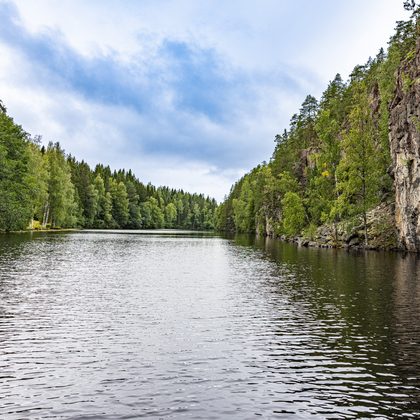
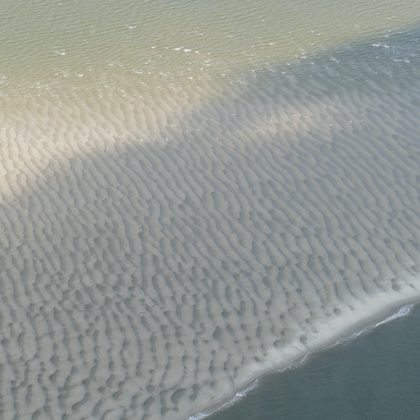
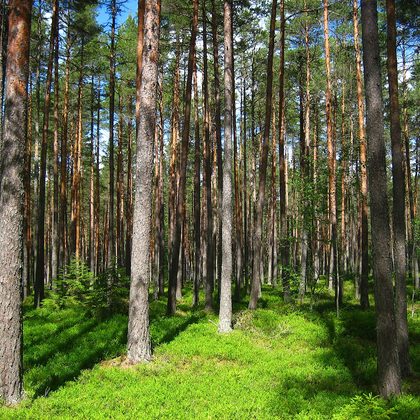
In Europe a coastal bird: harbour mouths, sluices, groynes and estuaries, and inland on large lakes and reservoirs, nearly always among Black-headed Gulls. On the breeding grounds it belongs to the boreal conifer forest, the only gull that regularly nests in trees, placing its nest in spruce or larch beside or over the water of forest pools and bogs.
Where the bird is most at home, classified with EUNIS — the European standard for habitats.

Range and movements
Breeds across northern North America from Alaska to James Bay and winters on the coasts of the United States, Mexico and the Caribbean. In Europe it is a regular vagrant, with roughly four out of five records from Britain and Ireland, and some individuals returning to the same site in successive years. Continental records are thinly scattered along the Atlantic and North Sea coasts.
Where and when to look
Search where Black-headed Gulls gather in winter: locks, harbours, fishing quays and the surf off an outfall. Work through a flock methodically, looking for the smaller size and the black bill, then wait for the bird to fly so the pale underwing can be confirmed.
Conservation status
Not globally threatened, with a large and apparently stable population across the Canadian and Alaskan boreal forest. European occurrence is a matter of wandering individuals, and yearly totals swing with observer effort and with autumn gales over the North Atlantic. Loss of boreal forest and changes to the water regime of breeding wetlands are the longer-term concerns.