All species › Passerines › Bearded reedlings › Bearded reedling
Bearded reedling
Panurus biarmicus | Baardmannetje | Bigotudo
Neither a tit nor a warbler but a family of its own: a tawny, long-tailed reedbed bird that you almost always hear first — a metallic ping somewhere deep in the reeds — and only then see, as a small projectile skimming low over the seed heads.

Voice
The call is the hallmark: a clear, metallic, slightly nasal ping or ching, often in short bursts and from several birds at once, as if small guitar strings were being plucked. Between them comes a dry rattling tsrrr as a contact note, and when a party flushes, an excited mixture of the two. Real song barely exists: the male adds no more than a few clicks and a soft rattling phrase to the ping. Audible all year, loudest on windless days in October and November, when parties tower above the reeds for the autumn dispersal.
Recording: Bubulcus — CC BY 3.0 · Wikimedia Commons
Identification
Small body, an extremely long graduated tail and warm ochre to cinnamon upperparts. The male has a blue-grey head, a yellow bill, a yellow eye and a broad triangular black moustachial stripe hanging from the lore down over the cheek — not a beard but a drooping moustache — plus black undertail coverts. The female lacks the grey head and the moustache: plain ochre-brown with a pale head and pale undertail. Juveniles show a black back and black tail sides. The flight is weak and fluttering, the long tail trailing behind like a streamer.
Confusion species
Hardly confusable in reeds. A long-tailed silhouette clambering through vegetation could be a Long-tailed Tit, but that is black, white and pink and keeps to scrub, not reeds. Reed Bunting shares the habitat but is streaked, shorter-tailed, has a conical bill and a completely different halting song. Juvenile Bearded Reedlings with their black backs are occasionally taken for something exotic; the call gives them away at once.
Habitat
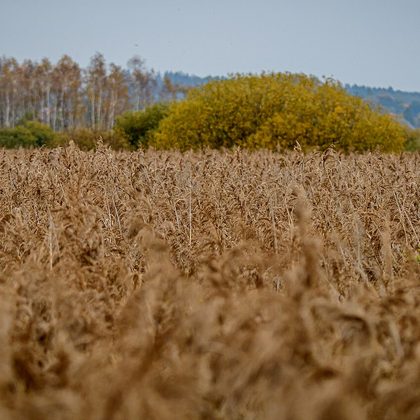
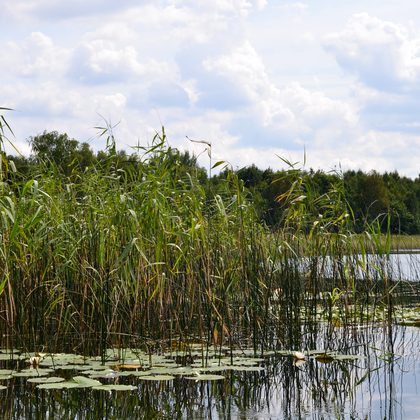
Strictly extensive, old, wet reedbed with a thick layer of dead standing stems: large marshes, peat pools, lake and lagoon shores and broad reed fringes along fresh and brackish water. Nests low in the reed, just above the water. Eats insects in summer and reed seed in winter, for which it retunes its digestive system in autumn and swallows grit.
Where the bird is most at home, classified with EUNIS — the European standard for habitats.
Range and movements
From western Europe in a broad, fragmented band to Central Asia, everywhere tied to reed marsh. The Netherlands is a stronghold: the Oostvaardersplassen, Lauwersmeer, Zwarte Meer, Nieuwkoopse Plassen, Zuidlaardermeer and the Delta together hold thousands of pairs. In Spain it breeds locally and in small, isolated numbers in the Ebro Delta, the Albufera of Valencia, Doñana and the lagoons of La Mancha.
- Resident
- Breeding (summer)
- Winter
- Passage
- Migration direction
- dark = core range, pale = thinly spread
Where and when to look
A windless, sunny morning in October or November, on the sheltered side of a large reedbed: parties of ten to fifty fly low across and can be watched balancing on the seed heads. Stand still and let them come to you; above all, follow the ping. In winter they favour the sunny side of the reed edge, low down just above the waterline.
Conservation status
Not threatened (LC), but numbers swing wildly. Hard winters with prolonged snow and ice on the reeds can halve a population, after which it recovers in two or three good years, since a pair may raise three broods in a season. In the longer run the real problem is the loss of old standing reed: annual cutting, drying out, over-rigid water levels and reedbeds turning to willow carr all make marshes unusable.