All species › Waders, gulls and terns › Gulls and terns › Audouin's gull
Audouin's gull
Ichthyaetus audouinii | Audouins meeuw | Gaviota de Audouin
A slender, long-winged Mediterranean gull with a white head, pale grey mantle, dark legs and a short deep-red bill. For most north-west European birders it is a holiday bird, and the way it hunts low over the surf, tern-like and unhurried, is what fixes it in the memory.

Voice
A dry, nasal voice: a barking kek-kek and a grating garr, without the laughing wail of the big white-headed gulls. Colonies produce a continuous, irritable rasping that carries a long way over water, while birds at sea are usually silent. Once learned, the tone separates it from Yellow-legged Gull in a Spanish fishing port without raising binoculars.
No freely licensed recording is available for this species yet.
Identification
Adults are white with a pale blue-grey mantle and a long, far-projecting wingtip carrying extensive black and small white tips. The bill is short and deep, coral red with a black band and a pale tip, and simply reads dark at any distance. Legs are olive-grey to almost black, the eye dark inside a red orbital ring, and the forehead slopes evenly so the head looks gentle and dove-like. First-years are cold grey-brown and strongly patterned, with a pale head, white rump and a broad black tail band; the dark legs and the long narrow wing remain the safest features at that age.
Confusion species
Yellow-legged Gull is the bird to measure it against, since the two share every Mediterranean harbour. That species has a heavy yellow bill with a red gonydeal spot, chrome-yellow legs, a pale eye and an angular, burly head; Audouin's has a short dark bill with the red band that looks plain black at range, dark legs, a dark eye and a softer, rounded crown. Structure differs just as much: longer and narrower wings, a shorter tail, and an elegant low passage just above the swell where a Yellow-legged travels higher and heavier. In a resting flock it stands out by its slim, long-legged outline and by the near-black legs among a row of yellow ones.
Habitat
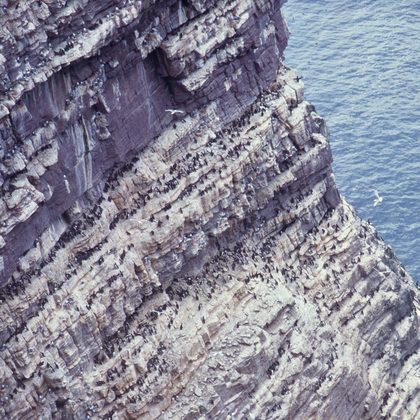
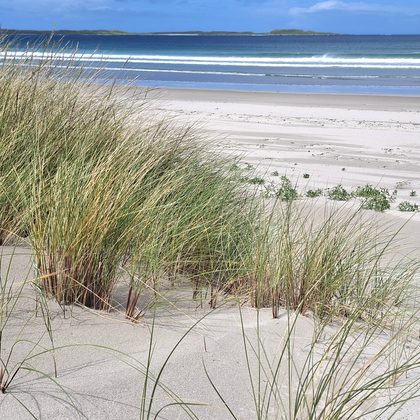
Rocky islets and cliffs, low sandy islands and spits, salt pans and fishing harbours. It feeds mainly out at sea, quartering low over the water for sardine and anchovy, much of it at dusk and after dark, and follows trawlers for discards. Fresh water is avoided almost completely; the species stays tied to the salt coast.
Where the bird is most at home, classified with EUNIS — the European standard for habitats.
Range and movements
Essentially the whole world population breeds in the Mediterranean, with Spain at the centre: the Ebro delta, the Balearics, the Columbretes, Isla Grosa and the Chafarinas, with further colonies on Corsica, Sardinia and along the North African coast. Outside the breeding season many birds move to the Atlantic coasts of Morocco, Mauritania and Senegal, while a growing number now winters on the Portuguese Algarve. North of Iberia it is a genuine rarity, with only scattered records from Britain, the Netherlands and the North Sea coast.
- Resident
- Breeding (summer)
- Winter
- Passage
- dark = core range, pale = thinly spread
Where and when to look
Work a harbour wall or groyne at first light or late afternoon: that is when birds shuttle low along the surf line and the legs and bill can be judged. The Algarve between Tavira and Faro is now the most reliable place for a first encounter outside the breeding season, with birds loafing on the salinas at high tide. Do not settle for the adult; the cold, contrasty first-years are the plumage worth studying while you have them at close range.
Conservation status
The IUCN Red List again treats the species as Vulnerable, after a spell in which it seemed to be doing well. From about a thousand pairs in the 1960s the population climbed past fifteen thousand pairs once the Ebro delta was colonised in 1981, and the listing was relaxed step by step. Since foxes reached the Punta de la Banya colony in 2017 that core has largely gone and the birds are now scattered over smaller and more exposed sites. Reduced trawler discards, predation by rats and Yellow-legged Gulls, and disturbance of low-lying islands all add to the pressure.